Layer not rendering when added to a View

Hi,

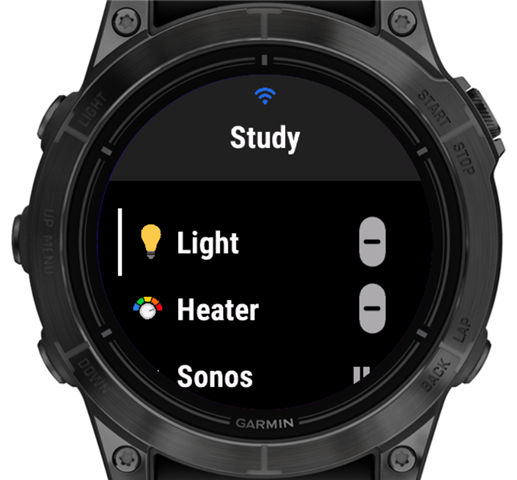
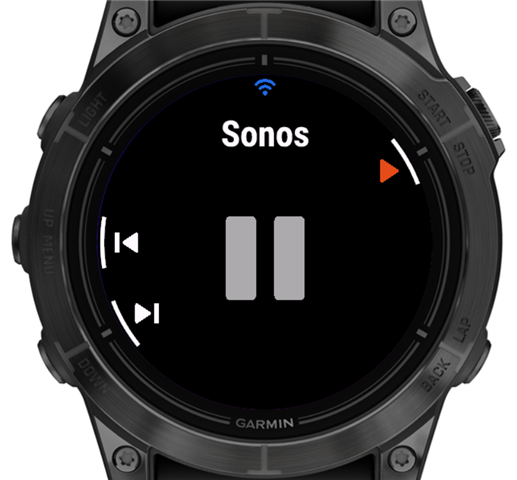
I’d like to use a layer to display a visual indicator in my app. The indicator should be a circle along the edge of the screen in a specific color, or a rectangle, depending on the screen shape. I want this indicator to appear not only on my own View implementations, but also on top of CustomMenu implementations, which is why I’m trying to use a layer.

I tried following the example in the documentation (https://developer.garmin.com/connect-iq/core-topics/user-interface/), but my layer never shows up.

Since posting code here often fails, I’m linking directly to the relevant files.

Layer implementation:
https://github.com/openhab/openhab-garmin/blob/main/source/connectivity/WifiIndicatorLayer.mc

I’ve confirmed the constructor code runs. A Dc is returned and drawing calls execute.

For testing, I added the layer to one of my views in the view constructor:
https://github.com/openhab/openhab-garmin/blob/main/source/user-interface/loading-views/WifiCheckView.mc

Is there anything else I need to do to get the layer to display?

Also, is my understanding correct that the layer is drawn on top of the view’s base Dc?

  • Do you need a layer for that? I don't use layers, I draw to buffers and add those together. On the end I check if I need to put something on top, and if so I put it on top, if it needs to go away, only the buffers are pushed to dc, and if something changes the buffers are redrawn.

  • I tried your code in the sim (for fr955), after disabling WifiCheckTimer to ensure that the wi-fi check view sticks around, and I see the same thing that you. (Ofc I run the app with BLE disabled).

    I found that, contrary to the example in the doc, it seems that drawing on the layer's DC in View.initialize() (either before or after addLayer()) is too early. Same with doing so in onLayout().

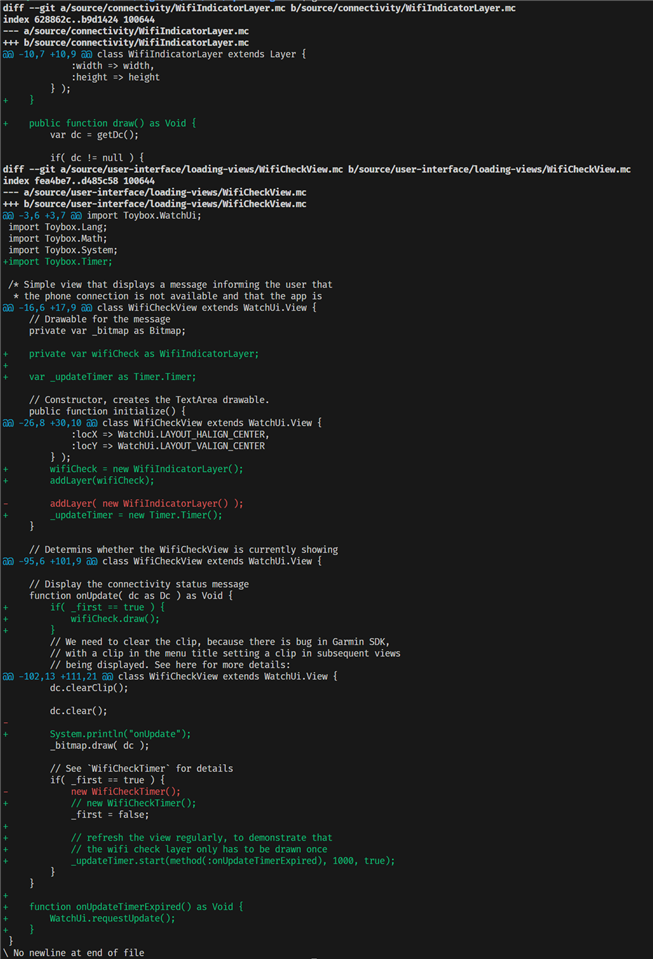
    The only way I could get it to work was to draw on the layer in the view's onUpdate(). I did find I only had to do this once. (I also modded the code to call watchUi.requestUpdate() regularly, to demonstrate that the layer only has to be drawn once, even though the View dc is cleared with on every update).

    These are the mods I made:

    Evergreen complaint: these forums suck

  • Thanks, I hadn’t thought about doing the drawing in an update. I’ll have to try whether it’s possible to reuse a layer across views without redrawing it. I also need to check whether overriding onUpdate() in a CustomMenu works reliably. In any case, if I end up having to touch every onUpdate(), the layer does not really seem to offer any advantage over a BufferedBitmap in terms of handling.

  • Like I said, I was able to get away with redrawing the layer once, but it had to be in onUpdate(). I don't know what happens if you then pass it to another view. Maybe you have to draw it once per view, idk.

    I'm not sure why it doesn't work as in the documented example. Maybe the layer receives a new Dc some point between addLayer() (whether called in View.initialize() or View.onUpdate()) and the first View.onUpdate().

    I also need to check whether overriding onUpdate() in a CustomMenu works reliably.

    I don't think it works at all (forget to mention that).

    CustomMenu inherits from Menu2, and Menu2 is some sort of wrapper around the native system menu, like ProgressBar is a wrapper around the native progress bar. I think in both cases, people have said they tried to override onUpdate() and it didn't work (onUpdate isn't called at all).

  • Yes, things like Menu2, progress bar, and TextPicker, are native views on the watch.

    On some devices you also can't use switchToView with an app's top level view and a native view.

  • I actually tried this before reading your messages, and you’re right: onUpdate() in a class derived from CustomMenu is simply never called. While I haven’t tested it, I guess that adding a layer would not work either, even if it were drawn earlier from another view’s onUpdate().

    Before considering layers at all, I also experimented with CustomMenu.drawForeground(). Although the Dc passed in appears to cover the full screen, anything drawn is clipped to the title area. The documentation says this method is called after the menu items are drawn, but that does not seem to be the case.

    Given all this, I’ll probably have to abandon the idea of using a screen-border indicator and fall back to displaying an icon somewhere instead.

  • I went through all this a month ago. Wanted to add a circle or rectangle frame with some color to indicate some state. It only works on my views, not on menus. So I also abandoned the idea. However now I have an idea: maybe Menu2's header or footer or theme could be used somehow. I haven't tried this, but from the docs it looks like they are dynamic and it's possible to change them.