Does startUserReview() work?

Hi,

I implemented startUserReview() when a user has spent some time and completed a reasonable level of interaction with the app and was expecting an uptick in reviews… but don’t see any.

I tested myself and see the on-watch “stars” review screen pop-up OK and then a bit of confusion when asked if I want to enter a comment: this invokes an additional on-phone CIQ connection page which I cancelled (not allowed to review our own solutions; it’s in the T’s and Cs)… so if someone complete a “stars” review, indicates to add more info but cancels that stage, should the “stars” review still be submitted without comment?

I see nothing coming through in the reviews.

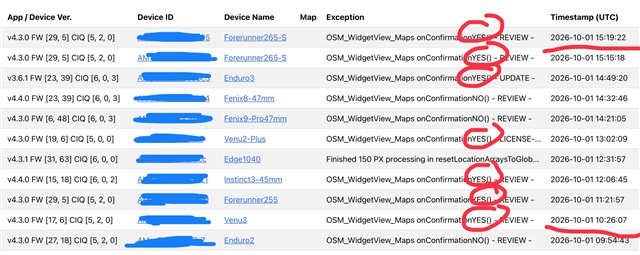
So I added an info log to a release and I see that I have 10+ people per day responding to a confirmation prompt to review which will show the startUserReview() but still nothing added to my review tallies for days and days now.

So does startUserReview() really work beyond showing the “stars” UI?  I appreciate there was a several-hour timeout on CIQ yesterday but the observed pattern/question stands.
Top Replies

  • It's an open forum. So, you might get things you haven't asked for.

    All types of response welcome and appreciated. Any conversation is better (including for future search and lookup…

  • you seem to think there is no possible downside

    It’s a good, healthy, rigorous debate that is opening far more thoughts and angles than I expected.

    But in response to the line above…

All Replies

  • No, you can't know that.

    I can know that… to *my* prompt that I use in association with a call to makeTokenReviewRequest and callback… I can’t know how many decline once in the process but 10+ per day accepting the *my* review prompt resulting in no/few actual reviews publically logged allows a legitimate question to be raised.

    With 120+ reviews at 4.6% I’m super pleased with logged responses but also see other apps logging 5* commented reviews with one-word review patterns very out-of-sync with other review patterns that give me little confidence in the process

  • OK, sorry for assuming you were incorrectly using that enum.

    Showing your own prompt before the system prompt might lead to another psychological reaction we don't discuss here: "What the ***? Are you asking me again? I already agreed. Get out of here!".

    also see other apps logging 5* commented reviews with one-word review patterns

    This was discussed recently. Most likely, there's some sort of review manipulation going on here: either bots are at work, or a "free key in exchange for a five-star review" scheme is in place.

    Both are expressly prohibited by the rules, but Garmin is simply ignoring these violations - just as it's ignored my numerous reports of issues, backed by clear evidence that 5-star reviews without any text for the same apps were left from the same set of accounts. They don't even react to outright offensive user review like "everyone who reads this is ...". I'm just fed up with this.

    One with 750,000 downloads and 179 reviews

    While acknowledging your immense contribution to this forum, I think you were just lucky that you were able to jump on board when the store was empty and get recognition.

    That bizarre reviews to downloads ratio tells me only one thing: you have an extremely high deletion rate. People see your apps at the top (where they got to precisely because of the lack of competition at the start), download and install them, but, not finding anything interesting in them, simply silently delete them.

    And yes, I know you get enough donations to buy every new Garmin device that comes out almost every month, but that doesn't disprove the high uninstall rate theory.

  • Making up stuff isn't real helpful.  Not all my apps are from 10 years back, and still have 100k downloads.

    The thing is I've never begged for reviews.Yet I have a bunch of contact with users.

  • Showing your own prompt before the system prompt might lead to another psychological reaction we don't discuss here: "What the ***? Are you asking me again? I already agreed. Get out of here!"

    I agree this is an unintentional consequence and could be attributing to the secondary drop-out rate - thanks for pointing this out. I still think there maybe a (common) edge case where the user commits a star value they are happy with, and is then presented with the “add more info” option from Garmin… if they subsequently don’t follow-through or cancel the additional info is the original star-rating carried through to the review? I would expect it to (it was still a valid rating) even though there was a second-part cancel.

    In terms of the other discussion point in relation to the value of reviews and engaging with users, I understand Jim and others view it could be invasive or negative. However, it is 2026… Google are often prompting me to review the cafe or campsite I just stayed at and they probably have a bigger HCI budget and input from a lot of research that supports this push engagement. 

    For small independent developers it offers two benefits also; firstly any engagement is good engagement (well, not anonymous negative reviews) and prompting “how ya doing” is OK… it opens a door to venting or praise and we (developers) getting end-user experience is more valuable than simulators or assuming interaction patterns.

    It also creates a feedback loop in that the more engagement from the users, the more the developer feels they are delivering a service and more likely to engage more time in fix/refine/improve. The user doesn’t know this is needed but dropping a solution into a void of response can be demoralising so feedback makes for better solutions.

    As alluded, I track user interaction with storage booleans to not re-prompt and only ask for engagement when the user has completed a significant number of interactions to try and avoid annoying pop-ups and getting feedback at a stage it’s not really relevent. Didn’t stop a 1-* “I’m still testing” feedback… but I’ll stick with my preference of 1% feedback leading to meaningful review stats, product improvement feedback and feel-good ongoing solution engagement from myself.

  • However, it is 2026… Google are often prompting me to review the cafe or campsite I just stayed at

    There’s a whole website devoted to mistakes Google has made.

    One difference is that people are going to blame Google for the annoying review requests. (And the fact that Google does this doesn’t mean people are not annoyed by it.)

    It certainly is 2026 and many people are getting then impression that things are worse now than they were.

    firstly any engagement is good engagement (well, not anonymous negative reviews)

    You know this isn’t necessarily the case. You probably won’t have any idea when disengagement occurs.

  • You probably won’t have any idea when disengagement occurs.

    I think that’s an interesting point. But there are a couple of ways to consider a response.

    Firstly if you don’t offer a review process, or signpost it, you definately won’t get any feedback, or much less. Again, a small sample, but if I have 1% of downloads engaging through review, then I only have 0.1% or less engaging through direct communication. I had a message last week “that link doesn’t work” WTF … countless people have probably clicked it and ignored it; so yes disengagement occurred but a process helped fix it.

    Secondly I think if there are good solutions they elicit generally good reviews. And poorer or not maintained (for whatever reason) apps and widgets get less. So you get more negative feedback when it’s due. But the way to get a more representative sample and get closer to the truth is to have a bigger ‘n’ or in other words The Wisdom of Crowds. Don’t ignore the outliers but welcome reports of bad experiences as the opportunity to fix/improve as long as the general quality of the solution is reflected in the overall numbers.

    When I look at an Amazon review I’ll often sort by worst and a quick glance indicates if it’s someone p’d off about the delivery courier or some other non-material impact which is OK, I can human-interpret that and make an informed decision on the actual product.

    What we can probably all agree on is that the overall CIQ review, response and publication process could be better.

  • I have a very low percent of users posting reviews.  But they are real users and real reviews.  I can tell with other interactions like being contacted that the numbers are real.  Things like requesting support for a new device or a new feature or something they don't understand..

  • When I look at an Amazon review I’ll often sort by worst and a quick glance indicates if it’s someone p’d off about the delivery courier or some other non-material impact which is OK, I can human-interpret that and make an informed decision on the actual product.

    We are talking about pop-ups asking for reviews. Not whether reviews are useful.

    One problem with reviews here is that some people use them to get support and leave poor ratings. This doesn’t help that user (much), is useless to other users, and a negative value to the developer. So, this sort of feedback in reviews is bad.

    Firstly if you don’t offer a review process, or signpost it, you definately won’t get any feedback, or much less.

    You contradict yourself. A review process exists without prompting.

    Again, we’re talking about pop-ups asking for reviews.

    One might not need a lot of “feedback” (reviews aren’t the only feedback). It might be better to have fewer higher quality reviews than lots of them (which aren’t all going to be quality and read by many people and might crowd out higher quality reviews


  • It might be better to have fewer higher quality reviews than lots of them

    I think this is the lower-level point where we diverge. You are right if you can get quality, but there is no method for that. You can leave a 1* no word review. And there are other examples of apps with many many low-quality (single-word) high scoring reviews.

    So without quality control, quantity - having a bigger n-value - is the only route to a better truth.

    And we know users are not great a finding the existing review process- many of them can’t find the app or data field they just installed, don’t update it, ask how to uninstall it, can’t find action-button menus etc… so:

    • if there is no quality in the review process you need to increase the sample size
    • if the existing review methods (to increase the sample size) don’t work you need to signpost

    There will be a good and valid counter position, but I think the discussion helped me focus and summarise it down to those two bullet points above for me

  • I think this is the lower-level point where we diverge. You are right if you can get quality, but there is no method for that. You can leave a 1* no word review.

    Pestering people might encourage more bad reviews.

    You are overwhelming looking at things from one side (your side). You aren’t “customer focus” and spend too much effort rationalizing your side.

    There isn’t really any benefit to the person being pestered to being pestered. There may not be any/much benefit to other users to them being pestered.

    • if there is no quality in the review process you need to increase the sample size
    • if the existing review methods (to increase the sample size) don’t work you need to signpost

    Not necessarily. There’s nothing that says this has to be true. You are just assuming that.

    It’s possible that forcing an increase in the number of reviews produces the same or even less quality. For something that some people find annoying and is becoming more common. Personally, I wouldn’t want to add to that (because it’s kinda rude).

    So without quality control, quantity - having a bigger n-value - is the only route to a better truth.

    Not necessarily, of course. A bigger N might mean more noise (and losing the signal).