
Temperature change causing elevation during activity

I have noticed that a temperature change causes a significant elevation change. This is particularly impacting the following situations:

1. elevation 'calibrated not during activity': this is done during the sleep window of the user. I am wearing the watch during sleep, which means that the calibration is done with watch temperature of 35-40C. During the day, the watch temperature is lower and the elevation increases significantly (tens of meters).

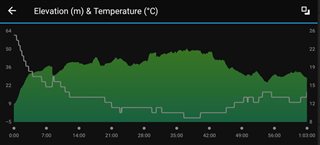
2. elevation 'calibrated at start of activity': this is done when starting a run for example. I am starting my run straight after exiting my house. This means that the calibration is done with watch temperature higher then during the run (note: it is winter here in the netherlands). The elevation increases signfiicantly during the first few minutes of the run (tens of meters). Example of a run on a near typical dutch flat terrain with very little elevation change (local DEM = 8m):
To illustrate the effect more clearly, i compared two cases where the watch was put down stationary on an outside table during the whole activity.

A. the watch temeprature was still warm (coming from inside), but gradually stabilizes to outside temperature.

B. the watch temperature is already stabilized to outside temperature
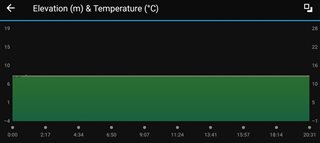
Comparing case A and B, one can see that the initial temperature acclimatization causes an elevation away from the initially calibrated correct DEM height (8m). I don't like this behavior since it significantly affects the elevation plot during my activity. 'Dumber' watches (eg Forerunner 245 without barometer, DEM, ...) seem to do a better job at the elevation plot during activities.   I would have expected that Fenix 6 Pro with DEM + GPS + barometer + temperature sensor + smart algorithms would be able to correct the temperature to elevation effect. I am hence wondering 

- if the behavior is recognized by more people;

- if the behavior is a SW bug, HW malfunction or a inevitable feature of barometer elevation (if so, how can i turn if off!)

settings/context with which above data is obtained

- watch mode: 'barometer' (but behavior also observed in 'auto')
- calibration during activity: 'continous' (but also 'at start')
- calibration not during activity: 'on'
- SW 13,3 (but behavior still present with 15.20 beta)
- cleaned sensor port (as per manual with warm water)

Top Replies

All Replies

  • i am absolutely experiencing the same issue in all the sport activities (run, trail run, cycling etc).

    it looks more relevant in the flat than in the mountains

    when i start an activity i have a sudden spike then it drops below the sea level and after 30/40m i got the correct reading.

    i tried everything (clean the sensor, change different settings) but still it's like that.

    it started to happen 3-4 months back but i didn't figure out if it is due to the winter weather/temperature.

    i was ready to ask for a replacement, but i see more and more people that is reporting this and i am afraid is more related to the FW. last year, same period i did not get this issue.

  • hi Simone,

    Thanks for your reply. Could you include the elevation with temperature overlay plot? thanks!

  • This looks very similar to what I observe (also since 3-4 months). 

  • I'm not 100% sure, but I think its been mentioned here before that altitude information logged during an activity is only based on the barometric altimeter, not GPS.  GPS altitude can be displayed during an activity, but the altitude logged for the activity is based on the baro altimeter.

    The fact that two of your data displays are flat would seem to support that claim.

    So, using barometer mode is not going to solve your issue.

  • I have the same issue. The net problem is that, when I go for a loop (starting and coming back from the same place) in the end the altitude is always higher than at the beginning, due to the temperature being lower. 

  • Hi, sounds familiar!  Could you please include a screenshot of elevation with temperature overlay? 

  • I don't have anything as dramatic as those already shown, but I can contribute with this:

    I started at 121 m and came back at the same spot at 128. In the middle, I stopped and sit down at a park: the autopause kicked in, and when I resumed walking the temperature had already risen from 16 °c to 28 °C, while the elevation dropped from 143 to 138 m. I DO NOT have autocalibration on, neither continuous nor at start, and this behaviour happens also when I never auto-pause.

    Basically what I think is happening is that the altitude is set at the beginning of the activity, when the thermometer is still pretty much reading just the skin, and as the temperature drops, pressure drops as well and it is read by the watch as a rise in elevation. In fact, all my to-and-fro activities read more altitude gain than drop.

  • Having a diff of 7m altitude for a walk start and end isn't unusual.

    How long was the walk.

    Did the weather conditions change.

    Any change in ambient air pressure will result in an altitude change of some sort.

    The baro in the watch is accurate to approx +/- 10 feet.

    The general lapse rate of air temperature is approx 1.98c for every 1000 feet of altitude under ISA conditions.

    So if the watch was using the temp increase as a guide to altitude change then  (28 - 16) / 1.98 * 1000 = 6060 feet descent. (temp increasing = descent)

    Which is clearly isn't doing.

    So the watch isn't using temp as a guide to altitude changes and if you think about it, it cant. The watch temp reading will change dramatically depending upon what the person is wearing, T-shirt, base layer, fleece, Outer shell, gloves, that it could never reliably be used for guessing altitude changes.

    Its more likely to be that the general air pressure over time is changing up or down, I have seen this a lot on my watch. I have every auto thing turned off  and so any pressure change the barometer measures is taken as a change in altitude. If I look at the baro graph over 12 hours and there is a trend up or down during that time I know the altitude is going to be wrong but in my use case I don't really care. To fix this, the trick is to recalibrate the baro every 30 mins or less if the have the information to hand. (its what pilots do all the time).

  • I know someone would post something like this. I said it was not impressive...

    Anyway, it depends on your definition of unusual. If you have 1 activity with this behavior, it's unusual. If, like me, you have dozens and dozens activities with THE SAME behavior, that's not unusual, that's a pattern. All of them end at a higher elevation than the start. ALL.

    That particular walk was 1 h, 5 km long, weather didn't change, but it's not that important.

    I know perfectly the temperature lapse rate, and I never said the Garmin was bluntly implementing that. I just said that I think Garmin is using that information for some lower-level correction.

    I know I am repeating myself a bit, but with my eTrex 30 I was performing 10-h-long tours, with thousands of m of elevation gain and loss, and when I came back to the start, it always gave me the same elevation (+- 3 m). And it didn't have a thermometer.

    Having a diff of 7m altitude for a walk start and end isn't unusual.

    How long was the walk.

    Did the weather conditions change.

    Any change in ambient air pressure will result in an altitude change of some sort.

    The baro in the watch is accurate to approx +/- 10 feet.

    The general lapse rate of air temperature is approx 1.98c for every 1000 feet of altitude under ISA conditions.

    So if the watch was using the temp increase as a guide to altitude change then  (28 - 16) / 1.98 * 1000 = 6060 feet descent. (temp increasing = descent)

    Which is clearly isn't doing.

    So the watch isn't using temp as a guide to altitude changes and if you think about it, it cant. The watch temp reading will change dramatically depending upon what the person is wearing, T-shirt, base layer, fleece, Outer shell, gloves, that it could never reliably be used for guessing altitude changes.

    Its more likely to be that the general air pressure over time is changing up or down, I have seen this a lot on my watch. I have every auto thing turned off  and so any pressure change the barometer measures is taken as a change in altitude. If I look at the baro graph over 12 hours and there is a trend up or down during that time I know the altitude is going to be wrong but in my use case I don't really care. To fix this, the trick is to recalibrate the baro every 30 mins or less if the have the information to hand. (its what pilots do all the time).