Paid CIQ Apps

I've always offered my data fields at no cost. I enjoy writing them and get a lot of good feedback about the value. I just loaded a new watch face on my watch and actually like the way this guy handles his app... after a couple weeks, a little key flashes that encourages users to contribute a small tip for a code to turn off the key.

So I'm considering something like that. I've never setup a way to get paid. I just read someone's post about a "$99 Garmin Connect IQ Developer Account", and "Garmin’s Adyen Payment Portal". Sounds painful. If you've done something like that, is it working out for you? Any tips on landmines? I just saw this green banner on my account, so Step 1 must be good to go.
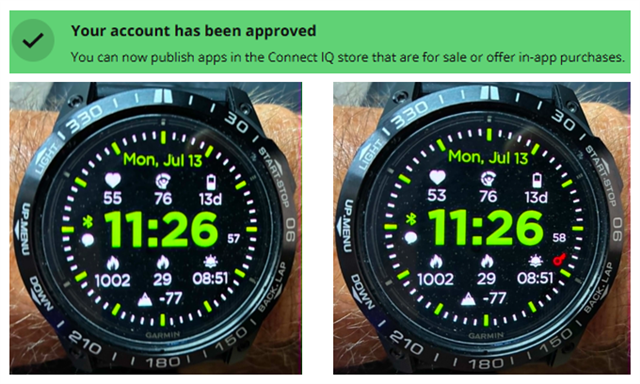
  • little key flashes that encourages users to contribute a small tip for a code to turn off the key

    Is he using Garmin’s payment system?

    I sort of doubt it.

  • I think he does. At least AI believes Garmin charges the annual fee and uses Adyen. But I think I'll go with a 3rd party solution.

    "Garmin processes its developer payouts via Adyen. Depending on where you live globally, configuring your local bank account to receive those payouts without getting hit by currency mismatch errors can occasionally be a major administrative headache."

  • When you weigh ease of implementation, cost efficiency, and user burden, the undisputed winner for the Garmin CIQ ecosystem is KiezelPay.

    While general digital storefronts like Lemon Squeezy or Gumroad are great for web software, KiezelPay was built specifically for smartwatches. For a Connect IQ developer, it hits the perfect balance across all three of your requirements.

    Here is how it breaks down across your criteria...

  • I would also recommend kiezelpay. You can have the trial time set as you wish, you can give free access to users (i.e after they help debugging some bug). Id say there are some minor disadvantages to it, but in most cases that is ok: 

    - It adds some code to your app (can be an issue for datafields on old devices)

    - Needs internet once in a while 

  • One of the things I learned (am still learning) when I integrated a payment / license option was the difference between a payment processor and a merchant of record. In the former, an org takes the payments but you are then responsible for the sales country tax. If you live in the US and only sell to the US - or similarly EU - then don’t worry. Otherwise, bearing in mind we are a global digital marketplace having a MoR is important…. But then you loose a lot of income via tax you may not have to pay. There are also middle-grounds with BYOP (bring your own processor) for certain countries within your MoR but that is more complexity for the return. 

  • Interesting. I asked Gemini about your reply... this was useful to me. Thanks!

    You do not have to worry about any of those tax or compliance headaches—KiezelPay acts as the Merchant of Record (MoR) and handles all of it for you.

    For an independent developer selling globally, this is one of the biggest reasons to use a platform like KiezelPay rather than setting up your own direct payment gateway (like Stripe).

    What KiezelPay Handles Automatically

    Because they operate as the MoR, KiezelPay is legally the entity selling the product to the end user. This means:

    • Global Tax Compliance: They automatically calculate, collect, and remit local digital taxes—such as VAT in the EU/UK or sales tax in the US—based on where your buyer is located. You don't have to register with foreign tax authorities.

    • Currency Conversion: They accept payments in dozens of global currencies and convert them, so you just receive your payout in your local currency.

    • Refunds & Chargebacks: They handle the administrative burden of processing payment disputes and refunds.

    Addressing the Point in the Screenshot

    The poster in your screenshot makes a valid point:

    "...you lose a lot of income via tax you may not have to pay."

    Here is what they mean by that: Some countries or US states have tax thresholds (e.g., you only have to collect sales tax if you sell over $10,000 or $100,000 worth of goods in that specific state/country per year).

    • If you sold directly: You wouldn't legally have to collect or pay taxes in those regions because your individual volume is too low.

    • Using an MoR: Because KiezelPay processes millions of dollars in transactions globally, they easily clear those thresholds. Therefore, they must charge and remit sales tax/VAT on every single transaction regardless of how small your personal sales volume is.

    The Bottom Line

    While you technically "lose" a tiny sliver of margin to automated taxes that you might otherwise have been exempt from on your own, the alternative is a logistical nightmare. Trying to manually track tax laws, file returns, and handle international tax compliance for a $3 to $5 Garmin data field is an insurmountable administrative burden for an individual developer.

    Using KiezelPay lets you completely offload that legal liability so you can focus strictly on writing your data fields.

  • When you are selling, there's more involved than sales taxes. There's also income taxes.  Say you sell $1000 worth of your app, and as an individual in the US, that's counted as "income" and things like a 1099 is involved.

    Income tax vs sales tax.  

    I'm pretty sure Garmin sends you a 1099 in time for April taxes.

  • I am paid to develop some CIQ stuff... paid generally thru PayPal invoices. PayPal doesn't report this to the IRS. But of course we need to report it. What I didn't know was we also have to pay Self-Employment Tax for SS/Medicare! Or, AI could be wrong. Do you know  ? Living in Florida there aren't State Taxes thankfully.

    ===============

    1. PayPal's Reporting Regulations (The Federal Threshold)

    Following the passage of the One Big Beautiful Bill Act (OBBBA), the federal reporting threshold for third-party platforms like PayPal has officially and permanently reverted to its original, higher limits.

    PayPal is only required to issue you (and send the IRS) a Form 1099-K if you meet both of the following criteria in a calendar year:

    • Your gross payments for goods and services exceed $20,000.

    • You engage in more than 200 transactions.

    State Exception: Be aware that several states (including Massachusetts, Virginia, Maryland, and Vermont) maintain their own state-level thresholds as low as $600. If you live in one of those states, PayPal will issue a 1099-K to satisfy state laws, even if you don't hit the federal $20,000 mark.

    2. Regulations for Reporting Your Income

    There is a massive difference between PayPal's obligation to send a form and your obligation to report your income.

    The IRS relies on a simple rule: All earned income is taxable, regardless of whether you receive a tax form for it. Even if you only make a few hundred dollars or a couple thousand dollars through PayPal invoices, it must be reported.

    How to File Side Gig Income

    Because you are sending invoices for a side gig, the IRS views you as a sole proprietor (an independent contractor).

    • Schedule C (Form 1040): You will report your total gross earnings from the gig on Schedule C under "Profit or Loss From Business".

    • Deduct Expenses: The primary benefit of Schedule C is that you only pay tax on your net profit. You can deduct ordinary and necessary business expenses to lower your taxable total. For example, the processing fees PayPal bites out of your invoices (typically around 2.99% + $0.49) are fully deductible business expenses.

    • Self-Employment Tax: If your net earnings from the side gig are $400 or more, you will also need to file Schedule SE to pay self-employment tax (which covers Social Security and Medicare).

    Best Practices Moving Forward

    Because payment networks and the IRS track gross volume, it is highly recommended to keep a clean boundary between business and personal transactions.

    If you are using a personal PayPal account for your side gig, consider opening a dedicated PayPal Business account or using a separate personal account solely for your gig invoices. This guarantees that personal casual transfers from friends or family don't accidentally get mixed into your business transaction history, saving you an absolute headache if you ever do trigger a 1099-K.

  • I wouldn't trust AI as far as I could throw it.

    Take to a tax professional in your area,

  • Agree. Hard to believe we have to pay SS/Medicare employer taxes for a side gig making over $400. I mean a kid mowing neighbor lawns would have to! lol