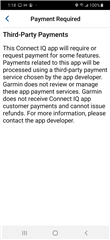
Is "Payment Required" a good label for your freemium app?

Any other developers feel that the coming "Payment Required" label is not helpful to users or developers when describing apps with a freemium model where the free version offers a great deal of functionality?

For my apps (dwMap and others) the free versions are fully functional, and are what the majority of users stay with.  I offer a Premium upgrade that enables additional features, but the App Store descriptions stick to the features of the free version.  I am concerned that potential users will be scared-off by the new "Payment Required" label from finding a very useful, free app.

How about three tiers of label: "Free" (no label), "Payment Required", and a third one "Payment Optional"?

I certainly applaud Garmin for providing users with clear labeling on paid products, and for now requiring that payment information be included in the store description, but wonder if this is the right initial step for this labeling.

Mappicus

  • They are a bit different as you don't pay for the CIQ app,  You pay for the service which is clearly separate from CIQ.

    If you read the description of "purchase" (click on it in the CIQ mobile store) there is this:

    Sounds like Garmin was kind of stuck in the middle where users were contacting them about payments/refunds/etc.

    BTW, this really isn't something that just came up a few days ago, as it was discussed at the developer conference back in October.

    With the rest of 2020 being during the holidays, I doubt there will be any changes before Jan 1st, so you may want to use the guidelines as posted for now.

  • Agreed. 

    Besides, I checked all mine and, if anything, sales went up. 

  • To be honest no one cared or was offended by freemium apps before so it must have been sufficiently clear to the end user.

    I think Garmin is missing the ball by the rules it has set for the flag now.

    Many freemium devs don't mind at all that users use their apps for free, it's not their ultimate goal to have "more" conversions and it's definitely not their intention to REQUIRE payment from the end user.

    For example I can vouch for mappicus his apps. His apps have a good free layer. I know this from experience as I've been using some of his apps for a long time on the free tier. A PAYMENT REQUIRED FLAG FOR THESE KIND OF APPS IS JUST PLAIN WRONG. (I eventually did buy a license for his apps because I think that good apps/devs deserve to be supported in order to motivate those devs to be kept on board of the community and to continue to improve their apps. I definitely did not buy a license because I felt required to do so, I bought the license because I wanted to do so.)

    I think we all agree that the kpay watchfaces needed some kind of warning system in place because it's paid ONLY and ALSO (MAINLY?) because it is/was CONFUSING the users. ESPECIALLY new watch owners that don't know well yet how to operate their new Garmin watch. I saw a few posts where people experienced it as their watch was being held HOSTAGE thinking the only way out to be to actually make the kpay PAYMENT. I've helped a few of these people myself and guided them how to change the active watch face and then to remove the watch face that they did not want to pay for. So for this particular case the payment required flag clearly applies and it is helpful in making it clear to the end user that the watch face will only work after paying the requested amount.

    However requiring the payment required flag also for apps that offer a good part of the functionality for free will make it back UNCLEAR FOR THE END USER to which behavior he ought to expect from the payment required flag

    ...and imho it will be in the disadvantage of the freemium app:
    - People will expect that it will act like the kpay apps. (apps require immediate payment. they do not function without payment (and/or hostage the watch with an accompanied payment screen))
    - Users which have no interest at all in paying for apps will not download an app which has a payment required label... (and the user will not be aware that there is a free tier in the app which is actually more than sufficient for his needs)
    - Freemium devs don't want to force users to pay for an app
    - Freemium devs don't want to be associated with the tactic of forcing people to pay for an app in order to use the app.

    What is the problem to be solved (or maybe I should say what SHOULD be the problem to be solved, namely make it clear for the end user what to expect when downloading an app) is not attained and you're back to square one...

  • On the other side of the coin, I get contacted every once in a while about getting a code for my apps to unlock advanced features, to provide an API Key, etc.

    The thing is, all my apps are 100% free, there are no unlock codes, and I don't provide API keys.

    There probably needs to be some kind of label for apps with a "paid" level, but maybe "payment required" isn't the best one.  But that's all there is for now and Jan 1st is coming up fast.

  • I believe everything in life is a compromise between ideal in one dimension and ideal in another...

    I agree with a lot of that, but also recognise the Garmin universe is vast and varied. And ConnectIQ, for all if it’s wondrous creativity and possibility, is not as significant a part of that universe as we might think based on developing in ConnectIQ. 

    For example, a very significant fraction of posts I see on social media are about the excellence of Garmin Instinct - which many people see as a valid alternative to Fenix 6 series - that has no ConnectIQ whatsoever. 

    I’ve also seen the mayhem in another brand’s marketplace. 

    Whatever Garmin does it has to be:

    • straightforward to implement 
    • low effort to manage
    • readily understood
    • difficult to abuse
    • effective

    Moreover, I really want to avoid (as, I imagine, does Garmin) the need for a formal approval process as that can really slow things down and frustrate... everyone.

    The payment tag seems to meet many of those criteria. 

    Yes, it is true that there are situations that it doesn’t fit perfectly- life is a compromise. But it prevents lawyering headaches from those who want to game the system. 

    If nothing else, it’s a step in the right direction. 

    Introducing another layer - “paid”, “freemium” and “free” - also introduces a grey area that must be policed. 

    And policing takes time, effort and resource that I’d prefer was instead spent fixing bugs like the obscurity flags that essentially cripple two-thirds of my DataField apps on many high-end devices...

    Also resource that might be spent fixing storefront issues like the fundamentally broken and inadequate categories system that is, from a developer perspective, a semi-randomised black box. 

    Or resource spent updating the web store to get back some fraction of the searchability that was lost with the last major updates...

    Or resource spent making the trending system work in a way that promotes good new ideas rather than either long service or gamesmanship. 

    As I say; this is progress. I applaud it. 

  • There's noone that asks that Garmin polices the tag, the purpose should be that the user can be properly informed as it's in the best interest of both the developer and the user to be able to do so. 

    I think I have been sufficiently elaborate why the system that's currently on the table is not good.

  • In my opinion, in order to cut off the flow of kpay, one should require from these applications the mark "does not function without payment". For applications with other payment models, the "trial period / limited functionality" mark is sufficient.

  • Just to note; Kpay doesn’t mean “no trial”, that’s an option that some developers choose and others do not. 

    Also, the issue is not “cutting off Kpay” which is a respected and respectable model with a large community of developers, but “stopping developers who spam and game the system”. 

  • Under the current guidelines, anything that uses kpay needed to have the "payment required" setting.  Is the owner of kpay making that known? 

  • It’s in his interest to do so!

    He has a reputation to protect...

    Behind the scenes, he’s quite actively promoting good behaviour - and not just with this issue.

    The problem here is shoddy developers who are using Kpay rather than Kpay itself. Not yet seen any dissent on the Kpay forum from developers either.

    The proportion of spammers is quite small... but they have been quite active.