Training effect totally wrong

Hi,

I just finished an easy long run and get as a result: Threshold run.

Training effect: 4.5 aerobic, 1.6 anaerobic. Excercise load 272.

Which seems far from the reality and throws off recovery time, training load, training status....

HR zone setup in garmin: LTHR 160 bpm, max HR 174, resting 52bpm.

My threshold speed is about 4'20"/k

Longrun stats:

1h40 minutes total,

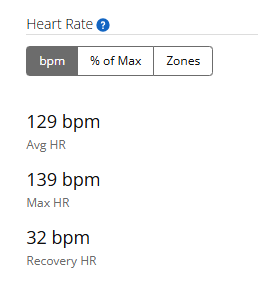
avg HR 129

max HR 139

avg pace 5'31"/k

max 4'51"/k

Which is all far from threshold.

Any idea what might be the issue?

One remark: I have a Stryd as footpod, and a Polar H9 as HR sensor.

  • Do you have your training zones on LTHR or maxHR?  I am not super familiar with how that changes or effects TSS or Training Effect in garmin, I have always kept it simple with max HR.  So take things with a grain of salt   these are just hypothetical cases/concerns that could skew the data, that would make me wonder about it.

    Your LTHR is a fairly high % of your maximum... like that of a pretty high level athlete, are you?  You sure your max is that, did you set it based on all out intervals or end of a 5k sprint finish etc?  if too low it will skew your training data being that most calcs are based on the MaxHR.

    Have you been doing similar runs lately?  How does it compare?  I just looked at a couple of my recent easy long runs (193max)

                 1h50min = load 148 , Base Low Aerobic , 3.6/0.0 ... 137/149bpm (71%/77%)

                  2h08min = load 172, Base Low Aerobic , 3.8/0.1 ... 135/154bpm (70%/80%) higher max cuz did a few 15sec strides at end

    yours avg/max were 74%/80% - so a bit higher in the range, could explain the Load.  Not sure it hints at the Training Effect #'s.

    How do your zones look like ?  What percent in each zone and what is the HR # ranges?   The 1.6 anaerobic is concerning?  I have a hard time getting that with intervals! lol

    Lap HR data is a bit more important or screenshots of profile.  Avg 'could' be skewed by very low HR during warmup/cooldown miles or miles with walking or frequent stops.  Then the rest could be at 135-139 which is nearly 80% of maxHR, which for me is mid Tempo HR. Was there frequent stopping or walking or slowing down?  Like running until HR hit 139 then intervening until it dropped... then running a bit faster again until HR hit 139?  Rolling hills messing with pace vs HR correlations? 

    Could just be bad calculation.  lol

  • This has been discussed for more than an year: Plcked up from Stryd support side: "It has been commonly reported that Garmin's VO2 Max estimate will drop if you connect a foot pod to the watch for pace/distance". This effects all external footpods, not only Stryd. I'm using Stryd as footpod, and have set both the speed AND distance to Indoor running when running outside. The Garmin results are ok, they don't messes up. I'm also using HR sensor.

  • Thanks for your reply!

    Woops seems like my 160 threshold was a type, it should be 154!
    But I'm fairly certain that I was way under my threshold, 160, or 154, whatever it may be.


    I won't expect any anaerobic or high aerobic effect with such zone distribution.

  • I understand that VO2max can be influenced by different measurements. Altough I see a different effect:

    got my Stryd from Jan, but also changed the way of training a bit.

    But anyway: moving a bit up and down based on VO2max measurements, I accept that. But when a totally aerobic run, slow, talking, breathing through my nose, singing and joking give as training effect: Threshold run, that seems way off and also derrails training load, recovery time, ...
    Which seems to remove the whole purpose of a smart garmin watch which keeps an eye on you and keeps you accountable to not overdo training.

  • Agree, I have seen other posts and I think even myself where a one off run like this is totally wrong.   I would do a hard restart if you haven't in awhile (press upper left button for 30+seconds until it goes black, and then turn back on), that often clears weird things like this up.  Will just need to ignore a bit of the data for a bit as it calms down from this long run's data impact.

  • It's not just VO2max that's affected, it's all the other running metrics and physiological measurements provided by the watch as well. Everything is interconnected and will give the wrong results.