Forerunner 255 VO2 max? what's wrong?

My new (since 30th october) Forerunner 255 has very weird behaviour for V02max calculation. I started out from previous watch, a 645 with a VO2 max on 51 and with the new watch it has linearly sloped down for each day and training. Now it says 43 but continously dropping. With now correlation to what I experienc and real efforts. two weeks ago I set a PR on the half marathon and during that week VO2max dropped 3 points. Doesn't make sense.

  • I will also say that obviously if your weight changes irl and all other things are equal, your VO2 Max (both real and Garmin-estimated) will likely change. But I think Garmin's method will automatically account for this due to the fact that your running speed will also change.

    It's the same reason that the Daniels VDOT calc doesn't need your weight even though it estimates VDOT / effective VO2 Max, whose units are still mL/kg/min.

    I will also point out that mL (of oxygen) are in the VO2 Max units (and definition), yet Garmin (and the Daniels calculator) don't measure mL of oxygen at all or ask you to provide any data related to oxygen.

  • So that means our running speed is also inversely proportional to our weight, then. Maybe close enough for estimation purposes? 

  • So that means our running speed is also inversely proportional to our weight, then. Maybe close enough for estimation purposes? 

    Right but my point is I don't think Garmin directly uses weight as a factor in estimating VO2 Max. That's why I don't think your weight needs to be correct in Connect for VO2 Max estimates to be "accurate".

    Losing a bit of weight should make you run faster (as long as it's fat and not muscle, and all other things being equal), but I don't think Garmin needs to know that you lost weight to calculate a higher VO2 Max value. Similarly, if I actually lose weight but somehow I manage to run at the exact same paces for the exact same heart rates, I don't think my VO2 Max value will budge at all.

    I could be wrong but I explained my reasoning in great detail. Notably, runalyze and the Daniels method for estimating effective VO2 Max / VDOT don't need to know your weight, either.

    And again if anyone wants to try doubling or halving their weight in Connect, they could prove me wrong. I guess nobody has ever done that for the same reason I don't want to do it - bc I don't want to mess up my Garmin data just to prove a point.

    By the same argument, I don't think Garmin uses age, height, gender, body fat %, etc. to estimate VO2 Max, even though those are all things that affect your running speed.

    I've heard that argument that weight must be taken into account because it's in the units of VO2 Max many times, but it's funny that the same people who say that don't consider that mL of oxygen is also in the units of VO2 Max, yet Garmin doesn't actually measure oxygen intake.

  • Sorry the link you posted doesn't work... It would be appreciated if we can take a look on it.

    Thanks

  • I will also say that the one physiological parameter which is def used by the Garmin VO2 Max estimation algorithm is max heart rate (that's how the algo extrapolates a maximal effort from a submaximal effort).

  • Thank you for the link. BTW, I can say that my HR max was 162 till one month ago, then Garmin automatically changed to 164 and in the meantime my VO2 max decreased. So that's what I saw and support your statement.

  • Thank you for the link.

    You're welcome!

    BTW, I can say that my HR max was 162 till one month ago, then Garmin automatically changed to 164 and in the meantime my VO2 max decreased. So that's what I saw and support your statement.

    Actually, I would say that an increase in HR max should lead to a higher VO2 max estimate (all other things being equal). And a decrease in HR max should lead to a lower VO2 max estimate. 

    The reason is because if your HR max is higher, then for any given effort with a heart rate lower than the max, the maximal effort should be faster. (This assumes a linear relationship between pace and HR as per the firstbeat white paper that was linked).

    e.g.

    Bob runs 10k in 50:00, with a heart rate of 150. His max HR is 180.

    Alice runs 10k in 50:00, with a heart rate of 150. Her max HR is 192.

    Alice's extrapolated maximal effort should be faster than Bob's, since her 10k effort at 150 bpm represents a lower proportion of her theoretical max effort, compared to Bob's effort, due to the fact that she should be able to push her heart rate higher than Bob during a max effort.

    It's the same idea behind hr zones which are expressed as % of max HR.

    If your VO2 Max decreased, I can only guess it's because you *also* ran slower for the same heart rate as before (or the same speed for higher heart rates). 

    If you did not run during the period that your VO2 Max changed, the change could also be attributed to older runs no longer being considered for your current VO2 Max. (Garmin VO2 Max appears to be a kind of rolling average which takes into account activities from a certain window.)

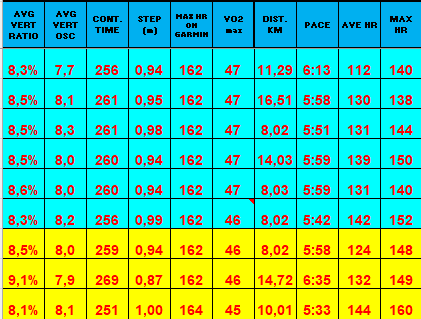
  • Here below my last 9 workouts:

    If you look at the last workout, my pace was faster than the others (5:33), consequently HR max was higher too. My VO2 max was decreasing from 46 to 45, and in my understanding my heart was obliged to higher bpm in order to counterbalance the less capacity to carry oxygen. Probably I misunderstood something but what I can see is if HR max increases, VO2 max decreases!

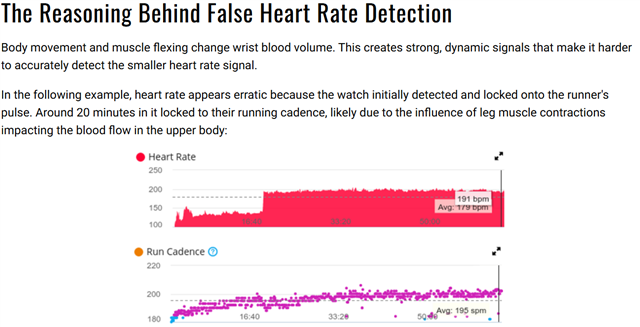
    Let me say that probably there are errors in the HR measurements, as I discovered HR increase just if my watch was more tight to the wrist. For this reason, I asked if it was possible that a loosen watch could affect HR measure and I got a detailed answer (probably not linked to the watch loosen or tight) but unfortunately I did not fully understand. Here below the snapshot of the answer where the graph is exactly what happened to me. There is a sudden increase that was (in my case) at the same time I tightened more the watch.

    The page is a Garmin official page just typing "Garmin Watch Optical Heart Rate accuracy tips"

    Could you comment the explanantion in the snapshot? 

    Thanks!

  • Probably I misunderstood something but what I can see is if HR max increases, VO2 max decreases!

    I'm saying that all other things being equal, if your maximum HR in user profile is higher, then your VO2 Max should be higher [*]. This maximum HR is the max HR your body can reach (for running), not the max HR that is seen during a given activity.

    In your comment/screenshot, lots of different things are going on: you ran activities of various paces with various average heart rates.

    [*] Let's use a very fake and simple example to see why this should be.

    Bob runs 10k at 50:00 at 100 bpm. His max HR is 100 bpm, so he ran at 100% of max HR. This is actually more than a maximal effort from him, because it's impossible to maintain max HR for 50 minutes. But let's pretend this is possible anyway.

    Alice runs 10k at 50:00 at 100 bpm. Her max HR is 200 bpm, so she ran at 50% of max HR. This is ofc unrealistically low for even an easy run.

    Can you see that Alice's 10k was an extremely easy run (50% of max HR), while Bob's 10k was a superhuman (probably impossible) effort at 100% max HR?

    Surely Garmin would estimate a much higher VO2 Max for Alice, since a higher VO2 Max reflects better fitness and a potential to run faster at max effort.

    In the same way, if one individual's max HR is set too high, it will trick Garmin's algorithm into thinking their "performance ceiling" is higher than it actually is.

    Higher max HR [*] = higher performance ceiling.

    [*] max HR for the individual, not for a given activity

    If you look at the last workout, my pace was faster than the others (5:33), consequently HR max was higher too.

    Well the fact that the maximum HR for that workout was high could explain why your max HR in user profile went up - I don't know how Garmin's max HR detection algorithm works, but I guess the watch figured that wasn't actually a maximal effort and that you could've pushed your HR higher.

    But again, lots of things are going in with your data besides a simple increase in max HR in user profile.

    If you really wanted to test what I said, you could change your max HR in user profile to something super high (like 190) and don't do any runs. See if your VO2 Max automatically goes higher. Ofc this may not work as expected, as your Garmin may or may not want to see another running activity before it changes the VO2 Max estimate. You could also try going for 1 or more runs in this state. I would expect your VO2 Max to eventually become artificially high, in any case.

    But ofc you probably wouldn't want to do that, since it would mess up your data.