GPS Polling Rate

Hello,
I am the developer of HotLap, and am very interested in the ability to change the GPS rate from the default 1Hz to 5Hz or greater.  It sounds like this is already a firmware capability for the default Downhill biking/skiing/snowboarding activity (which bumps it to 5Hz) for the Fenix 8 and other models, but there is no way to use/set the rate from the API that I have found.  Does anyone have any information or know of ways take advantage of the higher sampling rate as my app can dramatically benefit from these higher sampling rates for Motorsport use (at high speeds in cars/on track, etc).
Thanks in advance.
  • 5 Hz recording is one of the most desirable features of the speedsailing (aka speedsurfing) community, many of whom own a Garmin and wear it on the water (typically using the APPro Windsurf app). Without the 5 Hz data from the GNSS chipset (or suitable low pass filter that smooths the 5 Hz data prior to downsampling to 1 Hz) we see erroneous "max speeds", which people naturally assume to be true. 

    I have written a couple of articles touching on why it is so important that speeds can be recorded at 5 Hz (or higher). The first simply discusses the implications of sampling rates, and aliasing - https://logiqx.github.io/gps-details/general/aliasing/

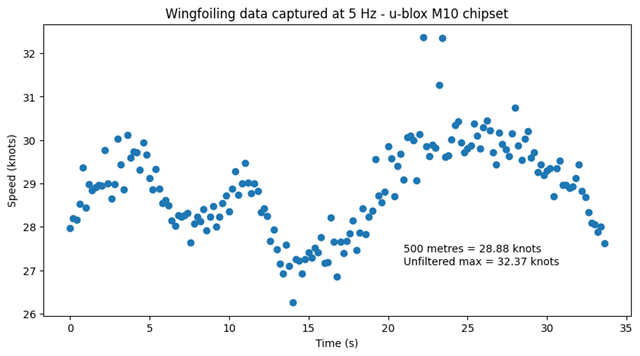
    The image below is taken from the first article and shows how indiviual readings are scattered around the true speed, but once in a while outliers are wrong by several knots. I don't expect anyone outside of the community to understand that our speed doesn't change by multiple knots in a split second, but it doesn't. The implication is that people are claiming speeds that they never achieved in reality, just errors. 

    The second article is more of a warning to speed sailors about how "max speed" can be misleading -  https://medium.com/@mikeg888/what-to-make-of-max-speeds-b83c05569e6c

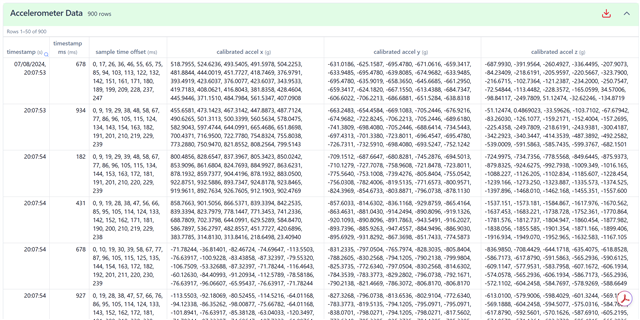
    It would be really, really useful if Garmin provided an option to record 5 Hz data, and it doesn't even need 5 Hz logging to the FIT file. Simply store 5 values within an array, just like IMU data (e.g. accelerometer and gyroscope) can already be recorded in FIT files at 100 Hz. This example of 100 Hz accelerometer data is from a Forerunner 255.

    5 Hz data inside the FIT file allows us to sort out these issues during the post-processing. I see no real reason why Garmin cannot provide 5 Hz logging of speeds, especially via the API. It would also allow them to provide better 1 Hz speeds for sports where it matters.

    Popular speedsailing websites:

    - https://www.gps-speedsurfing.com/

    - https://speedsurf.app/

  • This is fantastic...so many applications could benefit from 5Hz or greater, please Garmin consider this feature!  

  • Actually the speed comes from the doppler effect
    so for the speeds measuring itself for speed surfing theres no need to have more than 1hz. 
    math is simple - accuracy stays the same at all rates and it is 3meters at best. So if you get 10hz data and your speed is less that 30m/s (over 100kmh) you just get 10 points in the same circle. The appliances for this is in motorsport there you need to know speed AND position (yep i do racing i know what telemetry about) for each point. But even for club racing 1hz is enough to calculate lap timing if your startline is set there you go fast enough. Line crossing is calculated from the speed and position.
    it would be great to have better accuracy (less than a meter) for sailing races like course racing or yacht regatta as the speed during the race and start could be less than a meter per second. How ever i dont know any production chips can do that, there special appliances in geology and geography but not for consumers.

    and for the speeds because watches on the wrist you can make a record speed waving your hand in right moment (very easy to check slow riding the bike for example) so do not ever look at the pike speed, at least 2s average is needed.

  • Yes agree, and my use case is motorsport.  :) 

  • You have misunderstood the issue that we face.

    Individual point speeds relate to a very small time interval, typically between 1 ms and 20 ms, depending on the integration time within the tracking loops. The precision of the individual samples can be very poor at times, depending on numerous factors... measurement error, clock jitter, sudden movement, incorrect Kalman gain, etc.

    We use custom devices that record at 5 Hz, and average over 1 second or 2 seconds to avoid meaningless outliers. The combination of actual errors / noise and sudden movements are not far from being Gaussian distributed, so simple averaging of multiple points works well. You can of course do better... Savitzky–Golay, or Whittaker-Eilers, etc.

    Our custom devices give 1 and 2 sec averages which differ by only a few hundredths of a knot. However, Garmin watches with Airoha / Synaptics chipsets often disagree by several knots. If we had 5 Hz samples available, we'd be able to calculate averages and reduce the errors by an order of magnitude, much closer to our custom devices.

    There are instances where position and time are also important to us, but I left that out of my post for simplicity. I provide the hardware, software, and timekeeping for the International Speed WIndsurfing Class (ISWC). This includes events such as the ISWC Speed World Championship, but I didn't want to muddy the water (excuse the pun) by discussing that data.

    TLDR - 5 Hz data is super-valuable to speed windsurfing / kiting / wingfoiling, etc.

  • Speed windsurfing is about 40knots (records are close to 55). Doppler speed readings are accurate to at least of 0.1 m/s 

    Do you calculate speeds calculating the distance between points (averaged over second) ? 

    If so this explains the discrepancy. More over the higher the speed the less the difference. But i believe doppler speed should be used instead (and it is for a gp3s "certified" devices and apps) as far as i know

  • As a community, we have been using Doppler-derived speeds for in excess of 20 years, which is pretty much the whole time that I have been involved. I'm fully aware of how GPS works, and I am the main technical advisor for GP3S, plus other organisations. Claims about accuracy relate to some percentage of the time... typically 50%, 68%, or 95%. The rest of the time, errors are outside of this range and can range from small to very large. I have got Doppler-derived speeds which are wrong by hundreds of m/s during esoteric testing. There are numerous error sources that can affect Doppler-derived speeds, but 5 Hz data allows the subtle (but still significant) blips to be handled in an appropriate manner.

    https://www.gps-speedsurfing.com/info/about-us - Michael George, Tech Group Advisor