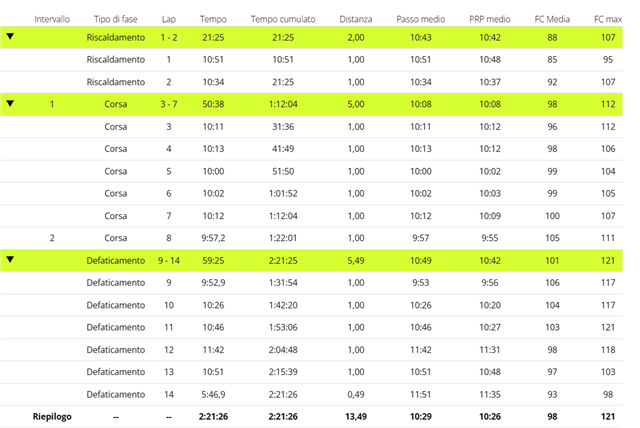
Garmin Connect activity summary

Hi all! What's the meaning of the column "PRP medio" ? Where is it in the FIT file?

I have downloaded the FIT file, but I did not find any data of the pace. Where are PACE data in the FIT file?

Furthermore, at the end of LAP 7, the earbuds notice was HR 102, but I can't find this value in the above table

Additionally, at the end of LAP 8, the earbuds notice was HR 109, but I can't find this value in the above table

What is the HR notice that is sent to earbuds?

Thanks!

Top Replies

All Replies

  • "PRP Medio" is the average GAP (Grade Adjusted Pace).

  • The FIT file has instant speed data (in metres per second), which can be easily be converted to instant pace in min / km or min / mile (and is automatically done so by Connect and other services which look at the FIT file).

    At least for older devices, average speed/pace (per lap, workout step, or activity) is calculated by Connect (speed = distance / time). Some newer devices may also write average speed to the FIT file.

    Not sure which tool you're using to look at the FIT file, but fitfileviewer.com is one of the best (and most easily accessible).

  • OK, I understand if running uphill GAP > pace, while downhill GAP < pace.

    Thanks!

  • Thanks, I use fitfileviewer as well. But let me say strange there's not the pace in the file. BTW, no worries!

  • But let me say strange there's not the pace in the file

    As mentioned above, it's because pace is easily calculated from speed, so there's no need for it to be recorded separately. If both pace and speed were recorded in the file, that would be redundant (and it could also lead to questions about which value is the source of truth, since, due to rounding errors, the conversion from speed to be pace would never be "perfect").

    It's just like how elevation is only recorded in metres, and not both in metres and feet.

  • OK, I understand if running uphill GAP > pace, while downhill GAP < pace

    I think it's the other way around. Running uphill GAP < pace, while downhill GAP > pace.

    https://support.garmin.com/en-US/?faq=BAoTNwybG874OFTrWhzlq8

  • Yes, sure! I meant GAP > pace as "speed faster than pace" ;-)

  • I think it's the other way around. Running uphill GAP < pace, while downhill GAP > pace.

    This just goes to show that most runners really think of pace as being synonymous with speed, but just expressed differently, even if they never really stop to think about it and articulate that in so many words.

    i.e.

    - most runners, when speaking colloquiailly, mean "faster" when they say "greater/high [pace]" and "slower" when they say "lower/less [pace]", even though, as you pointed out, numerically it's the opposite

    - to drive the point home, almost every running platform has a pace chart with an "upside down" y-axis where numerically lower (faster) paces are plotted above higher (slower) paces. In other words, higher (points on the chart) = faster and lower (points on the chart) = slower, even though the higher pace numbers are actually slower.

    If Strava and Connect suddenly flipped the y-axis to the "correct" orientation, 99% of users would not be happy with that change. It's only the super nerdy platforms like runalyze which even have that as an option.

    It's just one example of a case where the commonly accepted understanding is the opposite of the pedantic/technical understanding. And I think it's ok in this case.

  • Right, but if we don't agree on a clear definition of basic terms, like pace, we won't be able to talk about them without ambiguity.

    And the basics are:

    Pace is defined as the inverse of speed, i.e. pace = 1 / speed. Even if a runner writes “pace1 > pace2”, this means that the numerical value of pace1 is greater than the numerical value of pace2. Since pace is measured in time per distance, a greater numerical value for pace indicates a slower pace. This applies equally to runners as well as to physicists or someone else.

    Of course, one can say that pace1 is faster or slower than pace2, but when we use the math comparison operators "<" (less than) or ">" (greater than), it's common that we are comparing the numerical values.

    When plotting pace against time or distance on a graph, it is common to use an inverted y-axis for pace, as this makes it easier to quickly and intuitive identify trends where an improvement in performance (e.g. decreasing pace) is visible as an upward movement on the graph. I admit that this can be confusing, since the faster pace (with the smaller numerical value) is listed above the slower pace (with the larger numerical value). But that's just the visual rendering.

    The reason why pace is usually used instead of speed when running is that pace is a bit more sensitive than speed. At a speed of 10 km/h, this corresponds to a pace of 6:00 min/km. If the speed is increased to 10.1 km/h, the pace drops to 5:56.4 min/km. Thus, a small increase in speed of 0.1 km/h results to a more significantly drop in pace by 3.6 s/km.

    But there is also a drawback of pace, because for small values of speed it tends to infinite pace.