
Here's how bad the optical heart rate is on the FR265

There are a lot of posts on this forum of users experiencing erratic and/or unreliable heart rate readings from the optical heart rate sensor on the FR265. I am one of those users. I previously had a FR45 and do not recall any major HR inaccuracies from the OHR sensor on that watch. When I upgraded to the FR265 (or what I thought was an upgrade), I was shocked and puzzled that the heart rate reading was all over the place -- usually it was too low (based on what I know by feel) and often jumped up by 10, 15 or more beats from one reading to the next. The "solution," if you want to call it that, was to wear a chest strap. (FWIW, I tried multiple wrist positions and strap tightnesses with no improvement.) But again, I didn't seem have this issue with my FR45, at least not to this degree, so what is going on with the FR265?

I decided to conduct an experiment to see just how bad it is. I also have an Edge 830 that I use for cycling. So I brought my Edge 830 to the gym for a recent strength workout. I wore my chest strap and connected it to my Edge. My FR265 was on my wrist with the optical sensor reading my heart rate. I started activities on both devices simultaneously. After the workout, I downloaded the .csv data into Excel and plotted both sets of HR on the same chart.

Here are the results. The blue line is my heart rate as recorded by the Edge with a chest strap. The orange line is the FR265 with optical heart rate. The workout started with a casual 10-minute steady 7-MPH jog on the treadmill. The peaks that follow are my sets of lifts. 
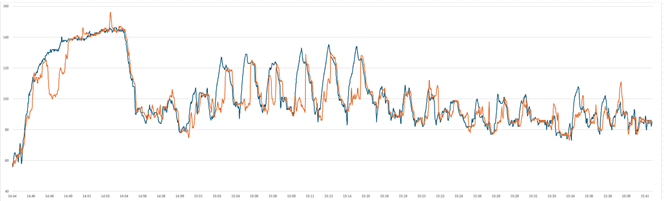
Note the gap between the Edge and the FR265 -- especially during my treadmill warm-up. What is going on here?? The FR265 was jumping up and down randomly. I have no idea what that random spike is.
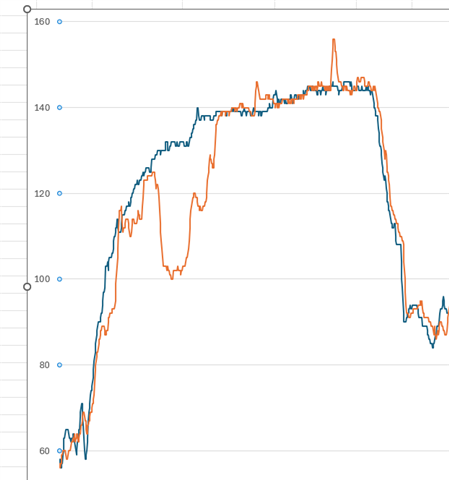
Here is my HR during some of the lift sets. Again, the FR265 HR was all over the place and the gap between the two is huge.
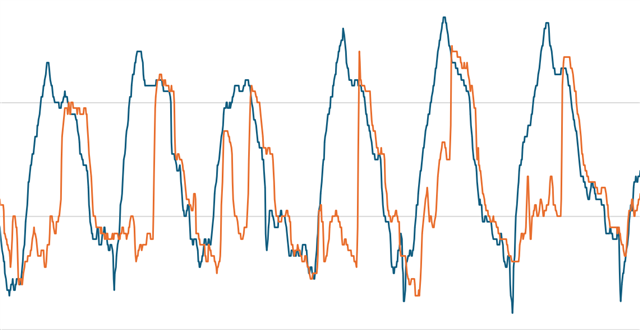
Some stats:

Greatest jump from previous reading: Edge: 6 BPM. FR265: 18 BPM. (How can my HR jump 18 BPM within one second? I had 13 readings where it jumped seven or more BPM within one second.)

Average difference between the two devices: 6.27 BPM

Greatest difference between the two devices: 38 BPM

Percentage of readings with more than 10 BPM difference: 20.1%

What this boils down to is that the OHR sensor on the FR265 cannot be trusted and is, in effect, worthless. The question therefore is what, if anything, Garmin is going to do anything about this. Considering the FR265 is no longer a "current model" on Garmin's website and has been superceded by the FR570 as the mid-tier running watch, I'd say the answer to that question is "nothing."

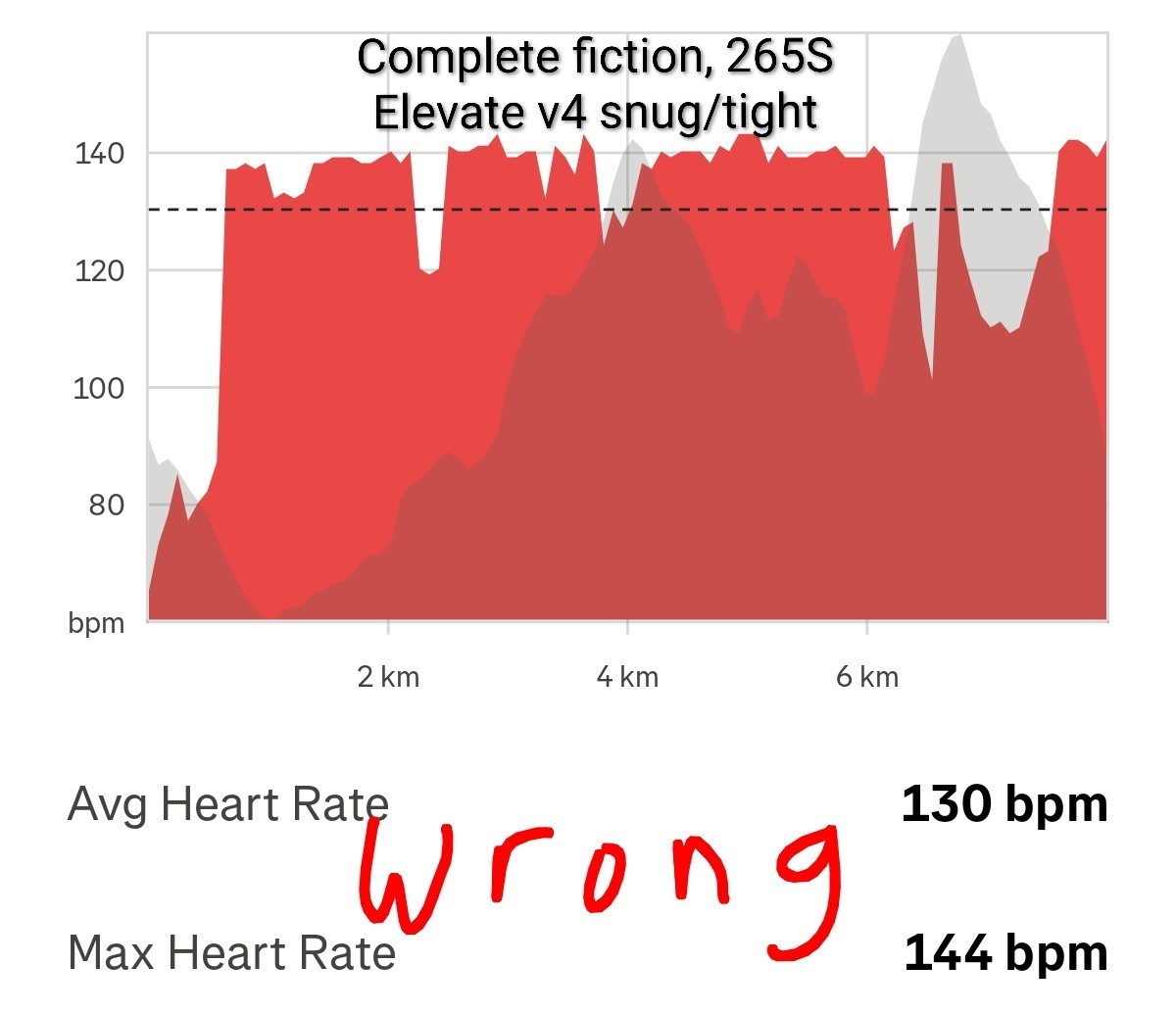
  • i have several runs all outdoors that are similar to this graph you posted, a lower than expected heart rate for the effort involved, then after 10-20 mins a step function up to the correct heart rate. For me, I think it is temperature related as it only happens in the cooler Autumn / Winter months.

  • Temperature related? Hmm.  Interesting.  I am wearing my 265 while on my Tacx trainer in my garage.  The temperature is a steady 16 c.  But knowing this I will keep an eye on it to see if temperature does have any impacts.

  • I've seen no correlation to temperature that I can pin down but I'm still on firmware version 21.20 and who knows in terms of individual physiology.  Indoor, outdoor over a wide range of temperatures I've seen the 8 minute sudden jump. Oddly enough I did a 6 mile run a couple of days ago, 53 degF and I got a different than usual response. Over the first 1:45, there was a 45 deg sloped ramp up in HR followed by about a 10 BPM vertical jump. I wish I knew what Garmin is doing exactly with the processing.

  • The biggest problem is that the issues don't follow a particular pattern. Some days it might behave pretty decently, but all of a sudden the heart rate could spike by 30 bpm for an hour, then suddenly jump back to where it should be.  The sensor seems to be capable of working fairly accurately but unfortunately the processing in randomly incorrect.  Of course the lack of an intelligent response from garmin doesn't help.  All they offer is the usual claptrap about how to wear the watch properly.  Blaming the customers instead of fixing the problem isn't going to solve anything 

  • My errant HR readings weren't temperature related either. Whilst I was outdoors it was 10C at the time and I took care to keep the 265 under my long sleeve. Seems to be movement in my case, when inactive it generally agrees with my known-good HRM strap.

  • Yes, the erratic nature is a problem. However, plausible behaviour is not necessarily fairly accurate - only with HRM strap used carefully can you properly know instantaneous HR. By carefully I mean with a good, moist contact and a snug fit. It's clear that there's a load more error correction in the background with optical compared to electrical HR measurement. My preference by far would be honesty - a small flag on the screen to indicate lack of proper signal, which carries through to the software with an option to delete that section. But that would be to admit how bad optical PPG is...

    Going back 10-20 years, Polar gave the option to manually correct failed readings in the software. So, when the chest measurement failed as you warmed up, or went past a powerline, you could tweak the readings so it didn't screw up your averages. That was when chest straps were less reliable than today, but still nowhere near as bad as optical.

  • I remember this -- I was a Polar user for years and used Polar ProTrainer 5 software, which was quite good and allowed me to easily edit erroneous HR readings directly in the software. Polar's replacement for ProTrainer 5, the web-based Polar Flow, wasn't nearly as good and was one of the reasons I finally decided to make the jump to the Garmin ecosystem with the Edge 830. (FWIW, Garmin Connect isn't as good as ProTrainer was either.)

  • The optical HR sensor on my 265 seems to still be messed up.  I did a workout on the trainer this morning. My heart rate, as recorded on my 1030 plus with a HRM Dual was 145 BPM.  According to my 264, my heart rate was 120 bpm.  I am concerned because I think the heart rate on the 265 has an impact on intensity minutes.  So the lower intensity minutes recorded by the 265 likely explains the lower than I would expect intensity minute reporting in GC too.

  • I have experienced a predominant but not always the same pattern, but that can easily be due the older installed firmware. A HUGE issue is that Garmin won't let you revert to an older firmware version if you update. So if you update and things get worse; to quote Mr. Bean in the movie Rat Race, "You are screwed".

    I understand there may be an interdependence with other features in regards to the HR processing but Garmin if I have to make a conscious decision to give up knowing that my circadian rhythm is out of sync with the phase of the moon, to get a reasonable (not perfect), repeatable, reliable Optical HR reading, I am all in. I don't care that it may miss some absolute instantaneous peak effort values. I can live with that and always put on a chest strap should I need that kind of accuracy,.. well I could put on the chest strap if it wasn't for the fact that a firmware revision which came after what I'm using has a fix for the chest strap; and the later versions of the firmware that are now available keep getting reports of broken features, like even worse response with the Optical HR, ect., ect. 

  • You can load older firmware versions on your watch