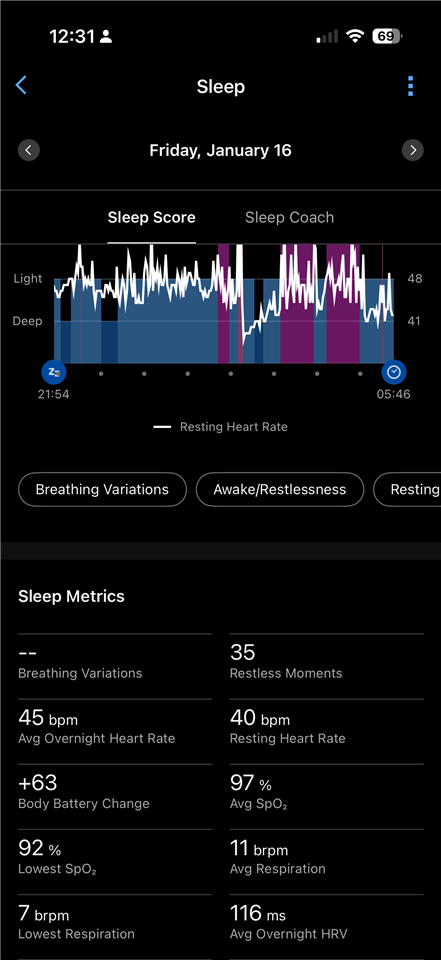
Evidence that the Index Sleep Monitor produces bad heart rate data

Since receiving a Garmin Index Sleep Monitor for Christmas, I noticed a step change in my resting heart rate. Based on other posts on these forums, I suspect there is an issue with this device, so I ran an overnight test, recording my heart rate with a Polar Verity Sense armband monitor and the Index Sleep Monitor (ISM).
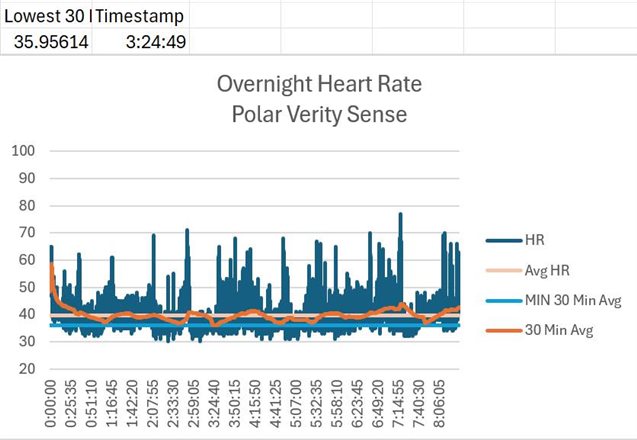
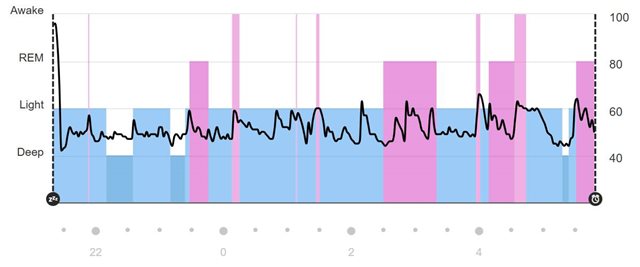
These images show heart rate data recorded from the Polar Verity Sense (right arm) and the Index Sleep Monitor (left arm).

As you can see, the two heart rates tell very different stories. As recorded by the Polar Verity Sense, I computed the lowest 30-minute rolling average heart rate (Resting Heart Rate), which was approximately 36 bpm. According to the ISM, my overnight RHR was 47 bpm, which was an 11 bpm difference.

Digging into the files stored on the device, I found a fit file called "settings.fit." 

This file contains numerous settings, some of which were incorrect. Most importantly, I see a setting "Resting Heart Rate (bpm): 50". I suspect the ISM has incorrect settings that are filtering data quality. I believe that the resting heart rate, as seen in the settings.fit file, is the device's reference heart rate (i.e., its true north). When the device strays too far from that, it corrects its signal effectively saying "I should be closer to 50 even though I see 36bpm...readjusting detected heart rate."

Performing a factory reset did not change the settings.fit file, as my resting heart rate is still the same as before.
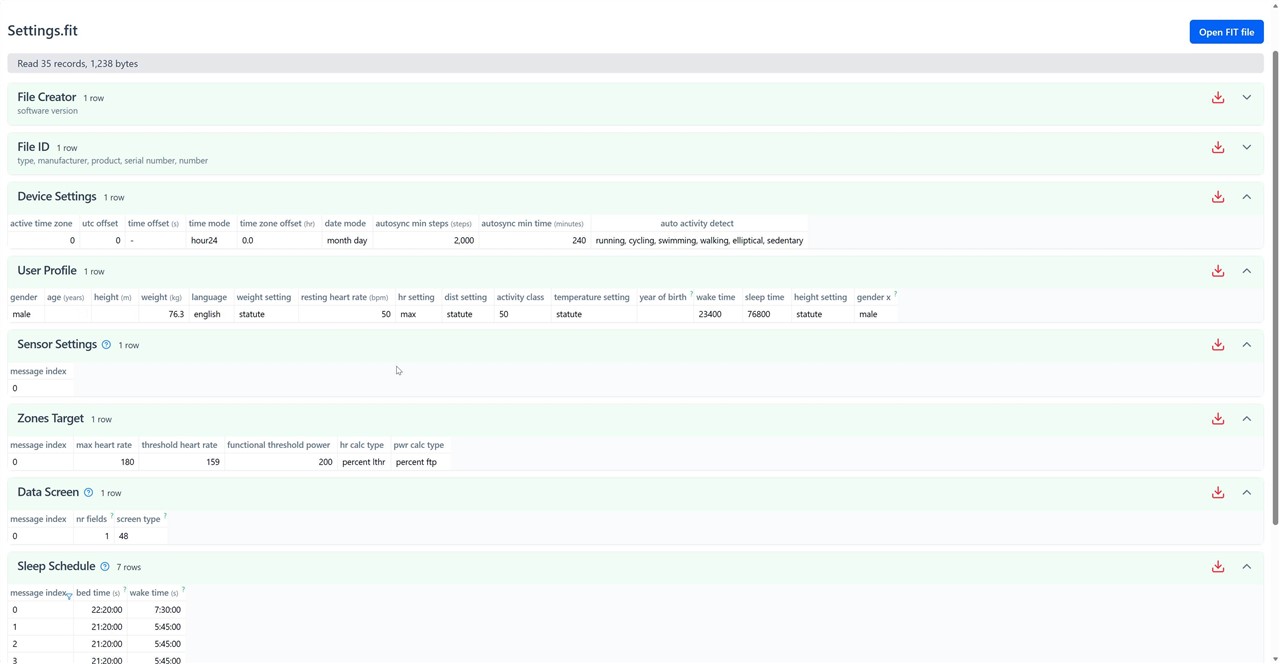
What I am unsure about is if 50 is a hardcoded number or not. However, given that other users have reported higher than expected resting heart rates using this device, I hypothesize that the users seeing the data might have a resting heart rate in the settings.fit file that is not representative of their true RHR as defined by Garmin's definition.

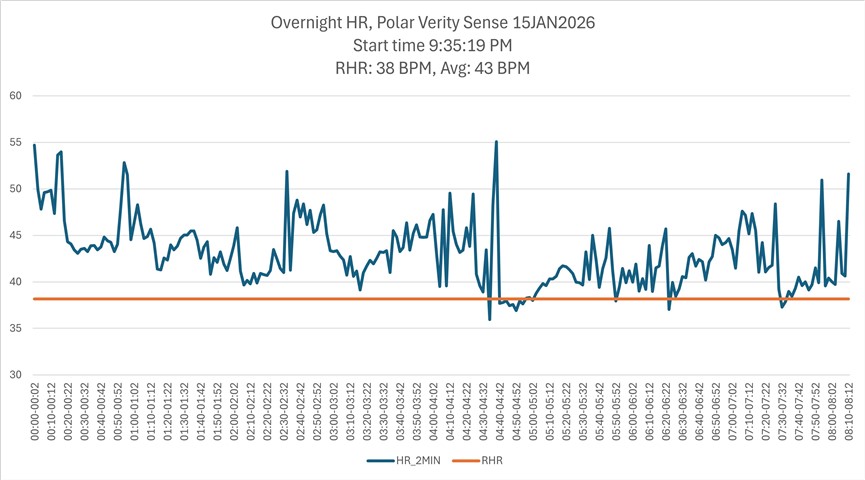
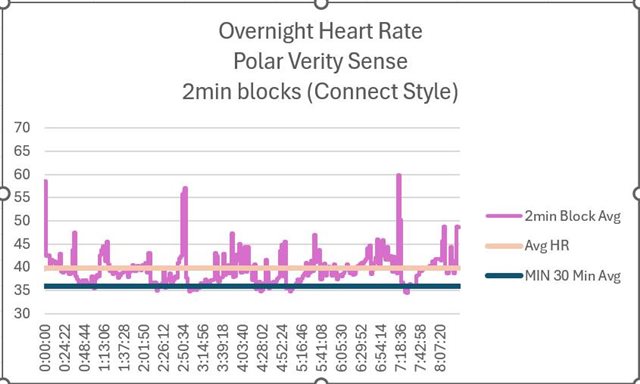
Edit: I am providing another chart that uses Garmin Connect reporting style in 2-minute blocks. You can still see there is a shift in the heart rate when compared to the ISM data.
  • That auto activity detect is quite interesting,  for a sleep tracker, lolz

    I recently bought one, could get one on massive discount, so willing to check it out, altough still on the fence

    Having said that I haven't  noticed anything really off to my usual metrics such as hr.

    However, 36bpm, is a pretty low rhr (no offense), so I can imagine that it may skew the avg. One would think it would take the rhr from Garmin settings, or what it measures.

    What I know from DC Rainmaker video, when he tried to use it to go running and stuff, it capped his hr at 140 about, so maybe it has a similar low cap. 

    I'll take a look at the settings file this week, see what it says.

    What does your RHR in Garmin Connect say?

  • Typically, my RHR is around 40. 38-42 was normal with the Elevate 4 sensor. I've also had two week-long EKG studies, and the Elevate 4 sensor was roughly in agreement with an EKG monitor. So, I have evidence to support the prior accuracy of my watch data.

  • My RHR has remained consistent between the Forerunner 265 and the ISM,  This might not be that surprising if both the ISM and the 265 are using the same algorithm to calculate the RHR.  

  • I was using the Forerunner 265 before the ISM as well. I also had an Enduro 2 that gave similar performance to the Forerunner 265. Unfortunately, it broke. 

    I wonder what your settings.fit file says. What is your typical RHR range?

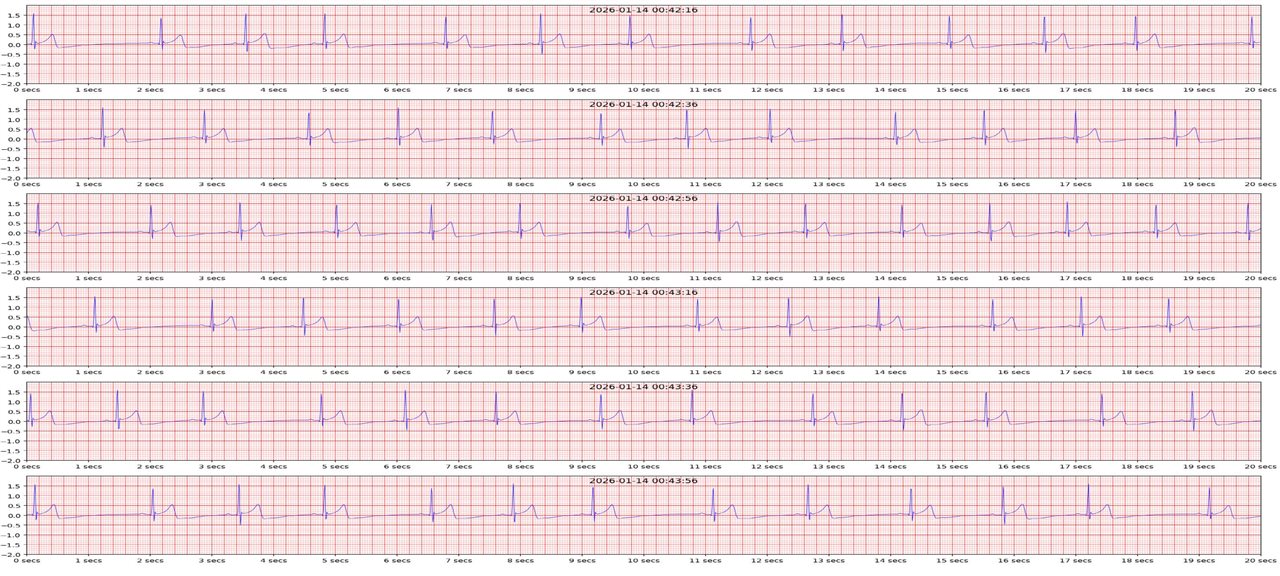
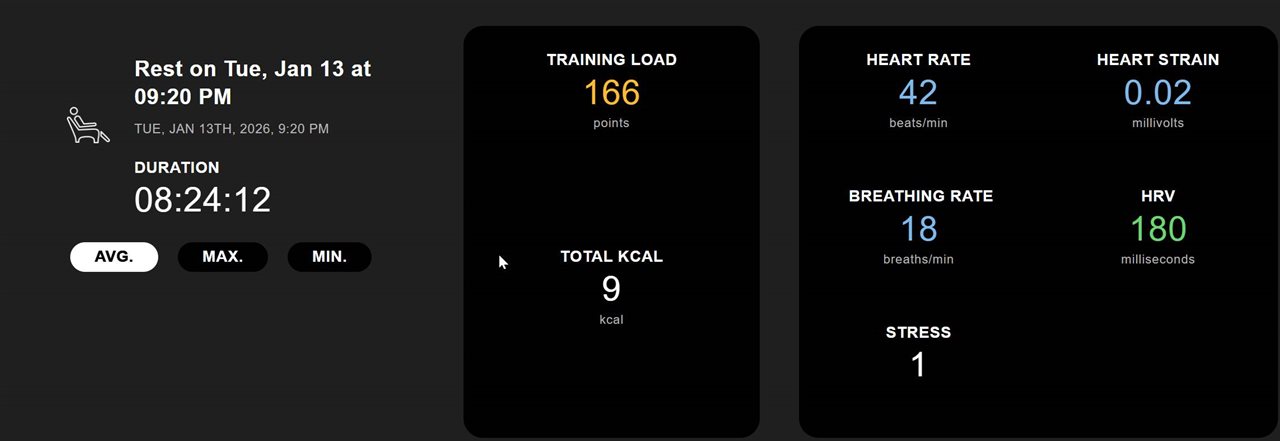
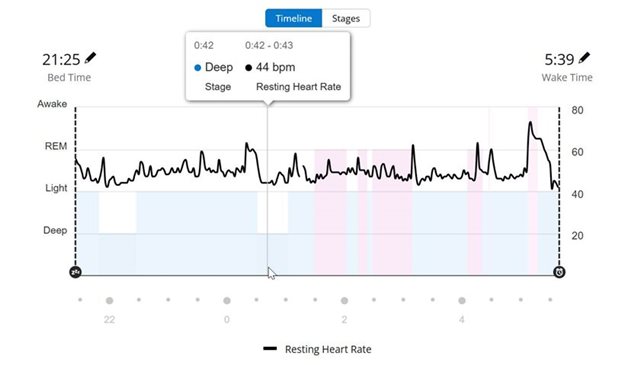
  • I took some more data last night, this time with the Frontier X2, which records an EKG waveform. Between 00:42 and 00:44, the ISM recorded an average HR of 44 bpm when the Frontier X2 recorded 38 bpm. The overall average HR from the X2 was 42bpm and the ISM was 46 bpm. Unfortunately, the X2 will not report heart rates less than 35 bpm, likely raising the reported average HR.

    Unfortunately, the Frontier X2 won't report a BPM less than 35bpm; however, there were some RR intervals of greater than 2000 ms, indicating less than a 30 bpm heart rate at times. While I don't expect PPG technology to accurately resolve beat-to-beat heart rates that low, I do think it should be able to detect BPM in the mid to high 30's bpm range easily.

  • For reference, I also have the Garmin BPM.  My RHR remains consistent across the BPM, ISM, and 265.  So whatever algorithm they are using, at least for me, seems to be consistent for each device.

  • Checked the settings file

    Mine has 50 RHR too, so this seems to be some hard coded basic setting maybe or a bug that it doesn't  get updated.

    What is weird  in my settings file none of the personal metrics except weight were correct. Someone else used this before me, and it looks to be their data maybe. I mean I didn't  change height overnight for example. Also the wake and sleep times weren't correct. This was after a factory  reset too.

    So, it updating the weight, that is something I manually do through Garmin Connect.

    I tried saving my non changed height and stuff through the Garnin website and then syncing through Garmin Express, but that didn't  change anything

    My Guesstimate is maybe  that some automatic updates are not passed along at this time, when it should.

    Either that or Garmin hard codes  it, but they let you set and have lower RHR in their watches and connect iiuc iirc so that wouldn't  make sense maybe

    One can set RHR manually in the Garmin Connect user settings.

    What you could try, I haven't  tested this, is change your RHR in the app and then sync, and see if it updates then. That could  be confirmation that there is some issue with automatic updating of user data on the device. 

    You could try changing your height etc too, your .fit file doesn't  show that, which can be an indication it didn't update that automatically either.

    As to reason why, we can only speculate, that is something only Garmin can answer maybe.

    I don't know where one would file a bug report if it is a bug? Iiuc this is something to discuss with Garmin Support. If you/we have more data for them might help them solve it, or help answer why this is happening or the reasoning maybe

    My RHR is  not 50, and besides the odds that 2 people would have the exact same RHR, using the same device, around the same time, are limited

    Maybe 50 is the default value out of the box, but it doesn't get updated automatically for an existing user. 

  • Hmmm

    I tried changing settings in the Garmin Website and Connect, and the settings.fit will not update whatsoever for rhr and age, height, etc

    Also I can't find anywhere in the website or Connect where to change RHR other than a watch, which having changed that, doesn't update the Index

    Wonder if this is at the root of some of the other issues people are having 


    Any thoughts on this? 

  • This will be my last data collection report as I've now tested the ISM specifically against an EKG, Polar Verity Sense, and the Forerunner 970. What is clear is that it autocorrects heart rate data to a ground truth. To be honest, using so many heart rate recording devices isn't very comfortable!

    What we know is that for the ISM Resting Heart Rate, as indicated in the settings.fit file, might be locked at 50bpm. 

    On 15JAN2026, I used the ISM, the Forerunner 970 with connectivity turned off, and the Polar Verity Sense to record heart rate data.

    The findings were interesting in that the ISM performed as we expected. The ISM resting heart rate was 5 bpm higher than the Forerunner 970. The Verity Sense RHR was 38, which was a little lower than what the Forerunner 970 detected, but was reasonable.

    I think the most interesting thing is that both the ISM and Forerunner 970 have HRV values that agree with each other, leading me to believe that the ISM does not use a corrected heart rate for HRV values.

    This is ISM Data. 

    RHR 45, AVG 46

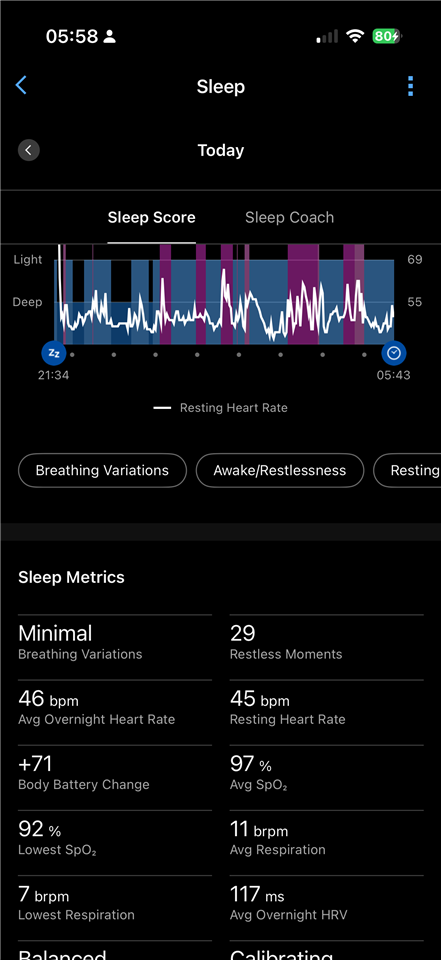
    This is Forerunner 970 Data. Connectivity was turned off overnight. The sleep file on Connect updated after syncing the watch, overwriting the ISM data.

    RHR 40, AVG 45

    This is Polar Verity Sense Data. The graphs look similar between the the Verity Sense and Forerunner 970, but the ISM heart rate graph is noticeably different.

    RHR 38, AVG 43