


FW 10.09, 2 day ago
the watch is lying on the table and the altitude changes +- 5 meters
does anyone have the same problem??
FW 10.09, 2 day ago
the watch is lying on the table and the altitude changes +- 5 meters
does anyone have the same problem??
the watch is lying on the table and the altitude changes +- 5 meters
does anyone have the same problem??
It is not really a problem, rather the expected behavior. It is a barometric altimeter, and a very tiny change of the air pressure or of the temperature will result in a different reading of the pressure sensor. 5m of elevation corresponds approximately to 0.05% of air pressure change - it is a very very small pressure difference, that can be easily caused by closing / opening the windows or doors, turning on heating or air condition, direct sun light entering window, air flow, etc, etc. And then, there are the atmospheric pressure changes - those are typically slow, and in some cases can be detected, if the watch is not just in the altimeter mode. By default, the altimeter switches between the baro and alti modes automatically, depending on the movement and pressure change patterns. However, when the pressure change is quick, or when you move in the same time, the pressure change will be very likely attributed to the elevation change.
Some more reading also here: Barometric Altimeter Accuracy of Outdoor Products | Garmin Customer Support
yes, i know, but with old fw (9.27) worked good, in night was altitude same, but now is +-20m
in night was altitude same, but now is +-20m
Perhaps because the temperature is moving more between the night and the day now. Personally, I do not observe any problems with v10.09, the elevation remains rather stable when I do not move:
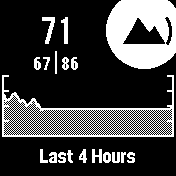
(I've been outdoors, the first hour here in this example)

last 4 hours in night
What is the Sensor Mode in the Alimeter/Barometer settings on your watch?
Automatic, auto calib.
Probably too many relatively rapid air pressure fluctuations in your house. Try setting the Sensor Mode to the baro mode for the night, or when you stay home, to see the pressure changes exactly.
I experience basically the same: I had I1, which had it's obvious barometer design problems and wasn't very accurate -partly this is the reason why I changed to i2solar.
And I was amazed in the first month! It was almost perfect, could even compensate the multiple single floor ups and downs a day. However, it is gradually getting worse since then up to the point where it gains up to +-100 meters of difference a day... and the weather is pretty constant now.
I totally understand, that it is pretty problematic, to take real elevation gain and weather fluctuations and other pressure changes apart, but Garmin is still guilty at ignoring this problem for really long.
I'm really not into it, but there are obvious solutions to parts of this problem:
-if the watch is not on you (hr sensor turns off, so it knows) and there's no motion, automatically change to baro mode (it doesn't do it now, gains altitude many times when I take it off)
-if it knows, that you are sleeping and there's no motion, automatically change to baro mode (maybe some fine tuning would be needed for on-flight or train sleeps, but should be possible to detect)
-if the phone is connected and it is granted location permission, provide sea level pressure updates for the current location and correct altitude to it (or at least detect if the difference get too high)
Those shouldn't be hard to implement, if they can manage to get running power from the wrist motion...
Maybe there are certain things I don't know about, maybe I'm wrong, but the first scenario above is really a silly mistake
Yes, I am sure too, that the algorithm can be improved, but it is more complex than you can see on the first glance. For example the accelerometer has its limitations, and will not detect low values, or steady movement at the same velocity, for example when slowly and steadily climbing or descending (i.e. slow elevators, escalators, vehicles). When the pressure changes caused by such movement are slow enough to match the common atmospheric pressure changes, then they will result in the baro mode and change the barometer value. But when the changes are faster and caused by a sudden pressure or a temperature change (i.e. due to forced ventilation, air condition, heating, indoors air flow, doors/windows closing/opening), then they will be considered an elevation change, even if the accelerometer does not detect the motion (for the above mentioned reasons). Could it be improved? I am sure it could, but there are limits, and it is much more complex than you think. Even if it can be better, it will never be 100% accurate.
if they can manage to get running power from the wrist motion...
That's actually not really from the wrist motion, rather mostly from the GPS data - it estimates (quite approximatively) the power using your speed, cadence, the terrain profile (slope inclination), and the wind (from a weather station, hence often quite wrong for your local situation)
I've had the S2 for half a year and I'm satisfied. Until recently, an error of 10 meters during an 80 km run, fantasy. I don't use the barometer during the day.
But it really seems to me that since beta fw 10.xx the accuracy has deteriorated, even when sitting the altimeter changes the height. I don't have a problem with the error 10km flat / 30m climbed, but 20 floors up while working on PC is weird
maybe I have a defective piece and will have to complain

