High Aerobic Load at Zero: a Bug or a Flaw in Garmin's Training Load Model?

First of all, I have already reported this issue in detail on r/Garmin, but I believe it is necessary to raise it here as well, since the problem has persisted for years now, unless I have completely misunderstood how Garmin's calculations work.

No matter which Garmin device I use, my High Aerobic load is permanently stuck at zero. This is not a new issue. It happens cyclically and repeatedly for several months every year. Since I've read hundreds of similar discussions over the years and none of them has ever solved my problem, let me clarify a few things upfront:

    Yes, my High Aerobic load is exactly ZERO

    Yes, my heart rate zones are set correctly

    Yes, I train for hours in heart rate zones 4 and 5

    Yes, I also use a power meter (for whatever it’s worth) with properly configured power zones

    Yes, my weight, FTP, personal data, and everything else are correctly entered

I see only two possible explanations: either this is a bug, or Garmin's calculations heavily penalize athletes who practice long-duration endurance sports. Let me explain with two examples.

connect.garmin.com/.../21937045842
In this activity I performed 8 high-intensity intervals, totaling 10 minutes in HR zone 5, 50 minutes in HR zone 4, and 1 hour and 23 minutes in HR zone 3. Despite this, Garmin labels the activity as Base (Low Aerobic), simply because after these very demanding efforts the rest of the ride was easier. The final result: High Aerobic Shortage, literally zero.

connect.garmin.com/.../22023520213
Here I spent 1 hour and 10 minutes in HR zone 4 and 1 hour and 30 minutes in HR zone 3, yet once again Garmin classifies the activity as Base (Low Aerobic), for the same reason: the remaining part of the ride was easier. Once again, the final result is High Aerobic Shortage, zero.

I may not be an expert, but I've always found Garmin's evaluations in these cases to be highly inaccurate. I could do 1 hour in HR zone 5 and end up in the hospital, but if I then ride 2 hours in HR zone 2, Garmin would still consider the workout "Base", basically a walk in the park. How does that make any sense?

In many endurance sports, a workout typically includes a relatively short portion of very demanding intervals, followed by a much longer period at low intensity. How can this type of training be classified as purely Base?

In practice, the only way to see anything other than Base as the Primary Benefit is to do short workouts: 10 minutes of warm-up, 30-40 minutes of hard intervals and 5 minutes of cooldown. In that case, the Primary Benefit will show VO2 Max.

But if instead of a 5-minute cooldown you decide to ride for 3 hours in HR zones 2 and 3, Garmin doesn't "reward" you, it completely dilutes your Primary Benefit, which inevitably becomes Base. And that's where High Aerobic Shortage probably comes from.

In short, I strongly suspect that Garmin penalizes athletes who combine high-quality intensity work with high training volume. Do you think this part should be reworked?

  • No, I haven't solved it.

    I've been complaining about this and reporting it everywhere for almost two years now, on Reddit and now here on the forum as well. At this point it's basically become a joke. I'm permanently stuck at ZERO High Aerobic and I'm pretty sure it would still stay at zero even if my heart rate reached 1000 bpm.

    I have an Edge 530 an Instinct and before that I had a Forerunner. The problem has always been there. The only difference is that in the past it used to come and go. Now it's permanent. I honestly can't even remember the last time it actually worked, maybe sometime in the middle of last year.

    What I still don't understand is how Garmin hasn't seriously considered that there might be an underlying issue to fix. For years I've seen people on Reddit reporting the exact same problem and they always get the same repetitive advice "check this setting, verify that value, adjust this parameter" but in the end nothing ever changes.

  • What I still don't understand is how Garmin hasn't seriously considered that there might be an underlying issue to fix.

    Probably because it works as expected for most users, just like it is the case with me too (using Instinct 3, but it was always credible even with my other previous watches).

    Though you may be right that if you mix a short VO2max workout, with a long easy run, the overall focus of the longer part will prevail. I recommend splitting the parts into two legs of a multisport activity, using the feature "Change Sport" ("changing" from Run to Run). If it does not help, record the two parts as completely separate activities.

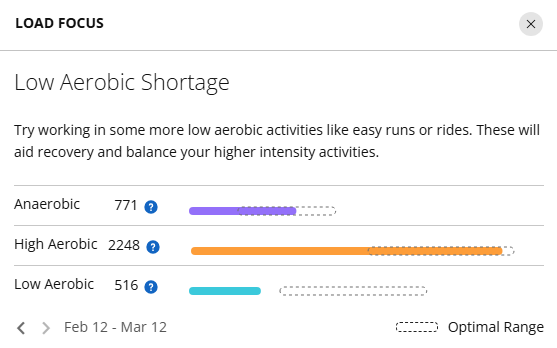
  • From what I understand, the High/Low Aerobic and Anaerobic scores represent units of training load (EPOC).
    In simple terms, 1 EPOC equals 1 point. This value is derived from heart rate, intensity, and duration.

    The higher the intensity of the activity, the more points you accumulate per minute.

    These values therefore represent the training load accumulated over the last 28 days.

    • Low Aerobic mainly corresponds to HR zones 1-2

    • High Aerobic mainly corresponds to HR zones 3-4

    • Anaerobic mainly corresponds to HR zones 4-5 with rapid intensity changes like sprints or intervals

    Over a 28-day period I spend dozens of hours in HR zones 4 and 5 and even more time in zone 3. On top of that, I complete around fifty sprints or interval efforts.

    Given this training distribution, it simply does not make sense for High Aerobic to remain constantly at zero. Out of frustration I even asked ChatGPT for help, and it suggested the following explanation.

    ChatGPT says:

    -------------------------------

    From my analysis, based on the information provided:

    • HR zones are set correctly (% of HR max, with correct max HR and resting HR)

    • VO₂max is accurate

    • Activity types are correctly categorized

    • No duplicate activities

    • Aerobic Training Effect consistently between 4.5–5.0, Anaerobic TE between 2–3.5

    Given all of this, the fact that High Aerobic load remains at zero in the Load Focus graph does not appear to be due to user error or misconfiguration.

    In my opinion, this is likely a limitation or bug in Garmin’s Firstbeat-based Load Focus algorithm. The model seems to interpret long, mixed-intensity sessions predominantly as Base (Low Aerobic), even when the actual physiological stimulus (TE) indicates very high aerobic and anaerobic load.

    So, while your Training Effect metrics correctly reflect the physiological stress, the Load Focus High Aerobic value does not, and this seems to be a known issue affecting multiple Garmin devices, including Edge and Instinct.

  • Training Load and Train Load Focus, although related, they are independent metrics. You can have high Training Load while doing only low aerobic workouts, as well as you can have a low Training Load wile doing high aerobic (or even anaerobic) workouts.

    I recommend reading up the following documents, explaining the terms, and the methodology. Especially the whitepapers from Firstbeat (Garmin's daughter) are quite detailed:

    BTW, Training Load that you see in Garmin Connect is typically the Acute Training load (which is a weighted sum of Exercise Load over the last 10 days, normalized to 7-day window). The 28 days weighted average is called Chronic Training Load, and it is a little bit hidden in Connect (you have to explicitly click the button Chronic Load on the Training Status page). Still, none of them can tell you what the Training Load Focus was. That's a separate metrics.