VO2 max levels

I have used Garmin Fenix for years - at first Fenix 3 and then Fenix 6 Pro.  

I'm not a keen athlete, but I exercise about 5-6 hours a week.

Garmin has always given me a VO2 value of around 34. I haven't paid any more attention to this - other than that the result is poor according to Garmin's table.

Quite by chance, I came across a VO2 chart for a person my age (male, 55). It had a completely different definition. 34 was above average - while Garmin said it was the second weakest possible.

Can anyone tell me - does Garmin measure different VO2 max value or does Garmin not know how to relate the VO2 result to the person's age or what is the issue?

  • Well, if you google diverse VO2max tables by age, you will find dozens of different variants, and the threshold values vary wildly. There is no absolute standard. It looks like Garmin uses their own data from tens of millions of users, and the rank you get, represents the percentile of users with corresponding VO₂max. So for example to get the level "Superior", your VO₂max has to be in the top 5%. VO₂max like the top 20% of users of your age category gets you the label "Excellent", etc.

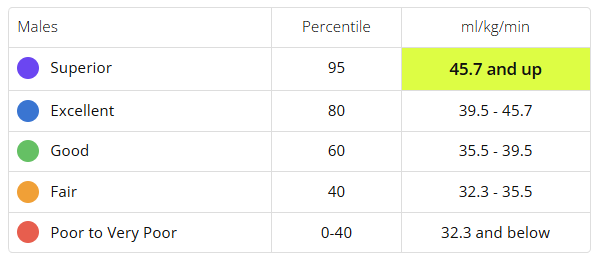
    See the table from the online help on the VO₂max page of GC web, for the percentiles of all levels (thought the percentiles are inversed there). The table below is valid for my age group. Check out the help page at https://connect.garmin.com/app/report/21/all/current for a table matching your age, or have a look at What’s a Good VO2 Max for Me? Your Aerobic Fitness Explained for the full table (and some more details)

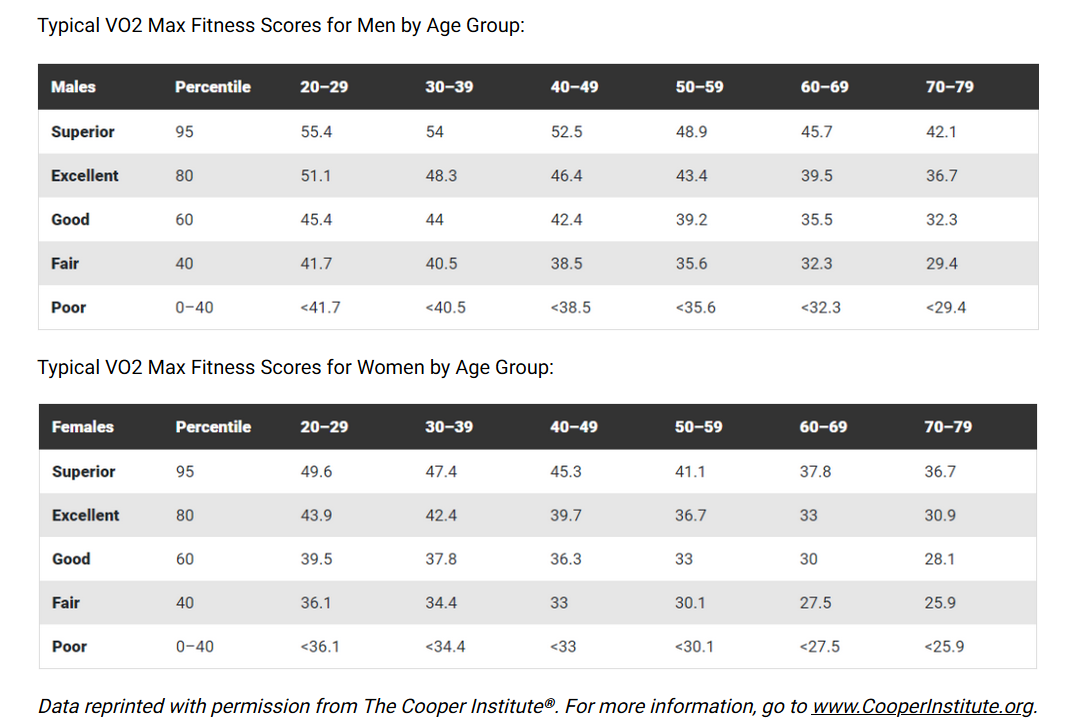
  • As per trux's final link and the Connect help, Garmin uses a standard VO2 Max lookup table from the Cooper Institute:

    have a look at What’s a Good VO2 Max for Me? Your Aerobic Fitness Explained for the full table (and some more details)

    My understanding is that this table is based on the general population, and not Garmin users. (Obviously - why would some random 3rd-party institute publish data only about Garmin users, without Garmin specifically calling that out.)

    If you open the Insights page in Connect [app or website], you can see how your VO2 Max [and other metrics] compare with Garmin users of various genders and age groups.

    For example, my VO2 Max is (supposedly) top 5% for my age and gender group aka 95th percentile, according to the Connect VO2 Max page, associated help, and the Cooper table.

    However, the Garmin Insights page shows the same VO2 Max as only placing me in the top 11% (89th percentile) of Garmin users my age and gender.

    This makes sense for the obvious reason that Garmin users are probably slightly more active than the general population.

  • Quite by chance, I came across a VO2 chart for a person my age (male, 55). It had a completely different definition. 34 was above average - while Garmin said it was the second weakest possible.

    Well according to the Cooper Institute table, a VO2 Max of 34 places you in the bottom 40% of the general population for your gender and age group. Garmin is just doing a table lookup here.

    If you want to see how you compare to other Garmin users, you can look at the Insights page in the Connect website or app.

    https://connect.garmin.com/app/insights 

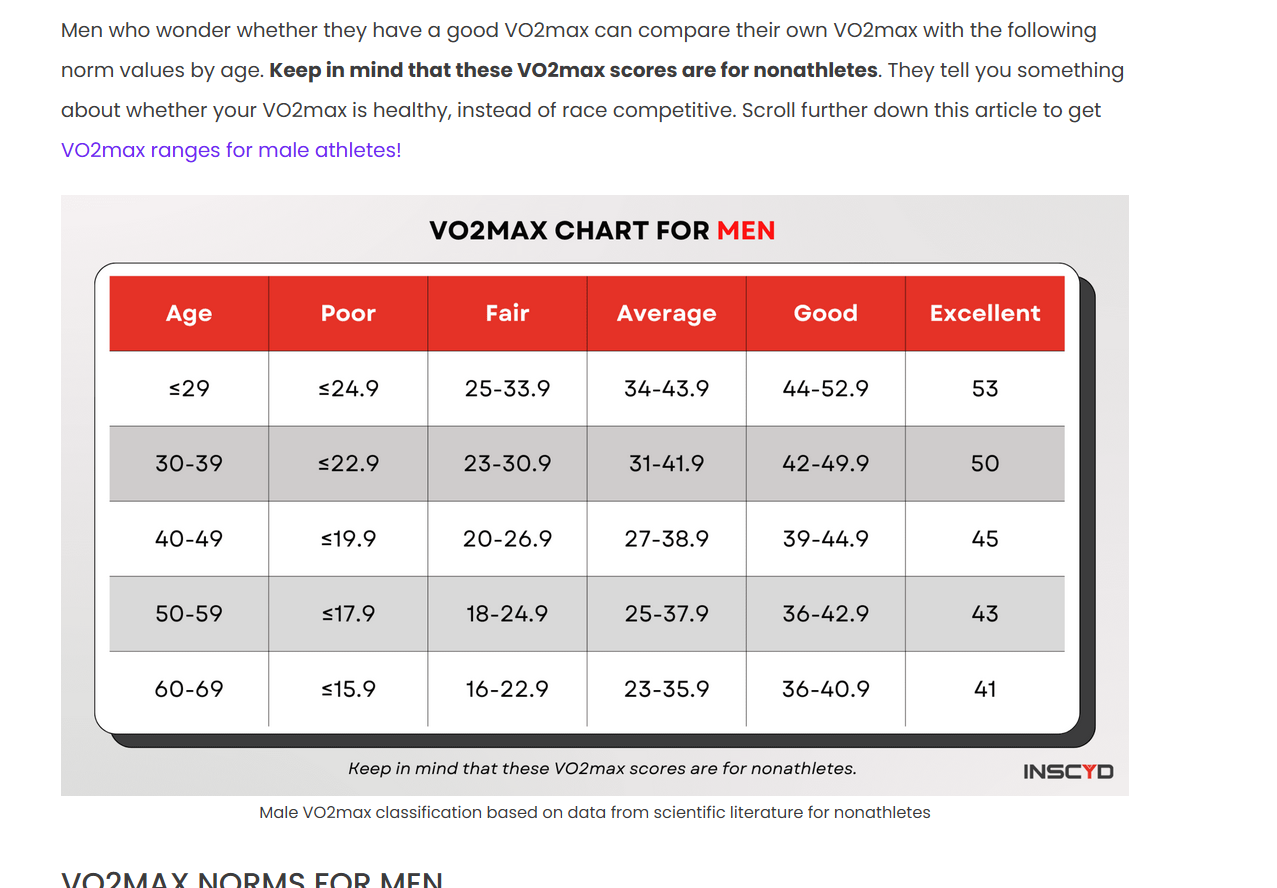
    Quite by chance, I came across a VO2 chart for a person my age (male, 55). It had a completely different definition. 34 was above average - while Garmin said it was the second weakest possible.

    Was it on this page?

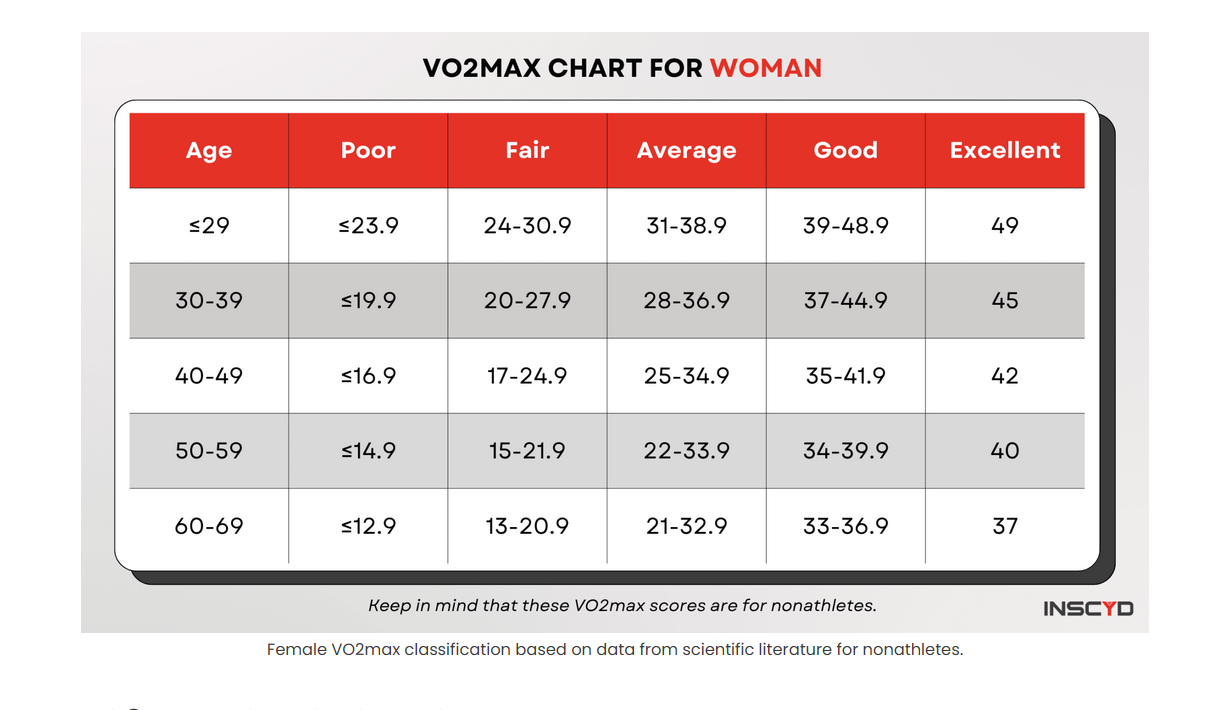
    https://inscyd.com/article/vo2max-charts-by-age-gender-sport/ 

    Indeed the classifications are very different. However, it doesn't seem like "poor", "fair", etc. are defined at all.

    It does say that the scores are for nonathletes.

    To play devil's advocate, one could say that 50th percentile is "average", yet Garmin would classify that somewhere between Good and Fair.

    I would suggest that none of this matters as long as you are healthy and enjoying your physical activity.

    Personally my goal is to run at a certain pace and to get faster while I can. I couldn't care less what the Cooper chart (or any other chart) says about my VO2 Max.

  • Thank you very much for your answers. This is probably about which group you compare it to. One table (Garmin 34 -> poor) and the other showing average. The "Friend" table here looks up to Excellent. It is probably a question of whether we are talking about athletes or the entire population. But thank you for your answers.

  • Like I said, the VO2 Max page in Connect (app and website) use the Cooper table which is supposed to be for the general population. This Cooper table has been an appendix in Garmin watch manuals forever. I think the classification on the watch itself is the same.

    So Garmin's classification of "poor", as referenced in your original post, is supposed to be in reference to the general pop (like I said, bottom 40%)

    If you want to compare yourself to other Garmin users, you can use the Connect Insights page.

    It's worth noting that the Cooper table simply lumps everyone in the bottom 40% together into Poor. It's like a failing grade in school: nobody cares whether you got 40% or 0% on the year for a course, right? It's still a failing grade.

    I suspect that the Inscyd charts I posted are a little more generous with the distribution / classification. Like maybe the breakdown is something like this:

    Poor: 0-20

    Fair: 21-40

    Average: 41-60

    Good: 61-80

    Excellent: 81-100

    Like a lot of numbers and stats, this stuff can be manipulated to tell any story you want.

    Again I would question whether it matters. Does it change your fitness or any of part of your life whether your Garmin estimated VO2 Max of 34 is classified as poor, great, or excellent? For that matter, who's to say that the VO2 Max estimate is correct in the first place?

    None of this even changes how fit you are or how fast you can run.

    If you really want to compare yourself to others, go out and run a 5k race or something.