Cadence and stride charts are wrong

Howdy folks, 

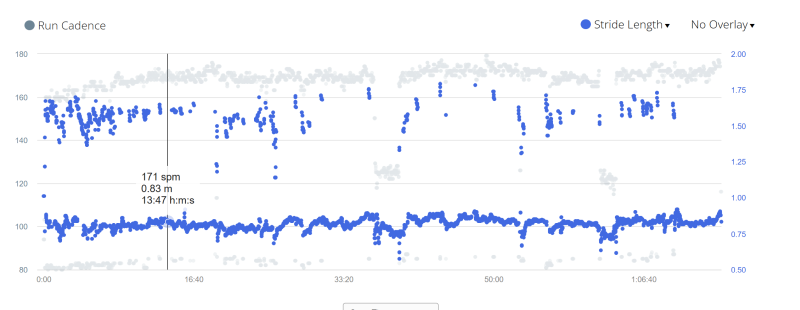
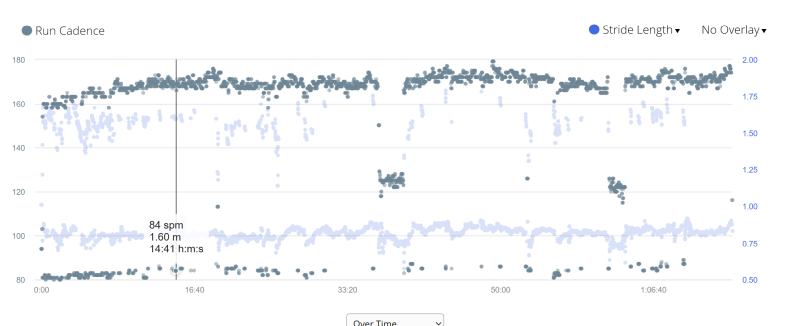
I got myself a Forerunner 255 recently and I was a bit confused at the way it reports cadence and stride length. I thought it was something to do with a recent firmware update, people say they've had the same issue, so I tried a downgrade and I go the same results. Namely, SPM would sometimes drop to, like, half of what it supposed to be, and stride length would basically double. And it keeps doing that. Anyway, Firmware downgrade didn't do a thing and I got to thinking, is it really the watch doing this? The pace it indicates is correct, which means that the measurements its making are correct. So, maybe, it's Connect getting things wrong? (I put screenshots from the web version because I'm writing this on a PC and it's just easier that way, but it looks the same on Android).

I'd appreciate any feedback on this, I really like the watch, but it'd be really nice if I could trust the data I'm getting from it.
  • This is unrelated to Garmin Connect. The cadence an stride length data come directly from your watch, Connect does not postprocess them in any way. I recommend posting the issue to the Forerunner 255 forum, or reaching out to the Support directly.

    Theoretically, though, it can happen even at a perfectly healthy watch too. Walking and Running generate very different acceleration curves. During running, there is always only a single foot briefly hitting the ground, while during walking you pose one foot on the ground while still standing on the other one. When walking is detected, the half-cadence is used, and that seems to be the case in your activity too. It could be certainly caused by a hardware or a software problem, but an unusual running style (for example a so-called "shuffle running", or speed walking instead of running, or using hiking poles) is the primary suspect.

  • I hadn't thought of that. I do tend to run slower than most, 7m/km. Well, that brings up new possibilities for figuring this out. Thanks.

  • ... what could perhaps help in such case, is an external HRM with an accelerometer, such as HRM-Pro, or HRM 600 (3rd party chest straps won't work for this purpose). The acceleration curve detected by the chest strap is simpler, since it is not influenced by the swinging arm, hence there is a chance (though no guarantee) that it could work better even at runners with unusual running technique.