


I have been testing a Fenix 9 Pro Solar 51 mm side by side with my Fenix 8 Solar 51 mm for several days now. Rather than repeating the specification sheet, I wanted to concentrate on the differences that have actually become noticeable in direct use and in repeated measurements.
Some of the results surprised me quite a bit.
Design
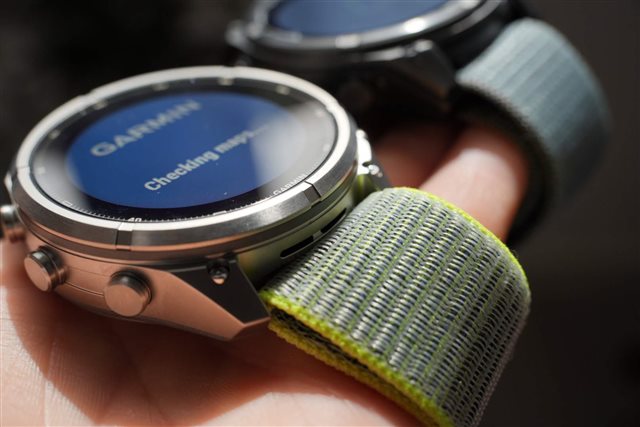
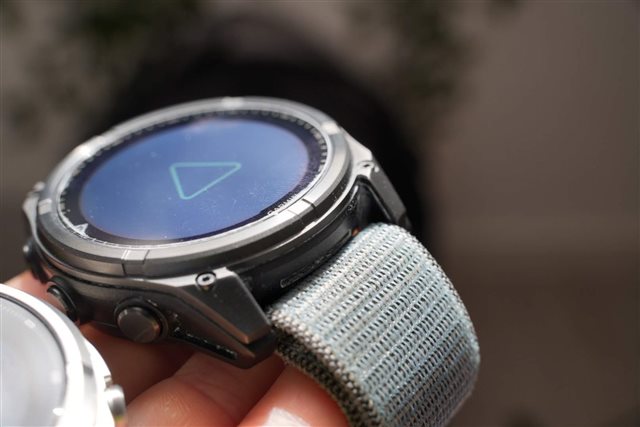
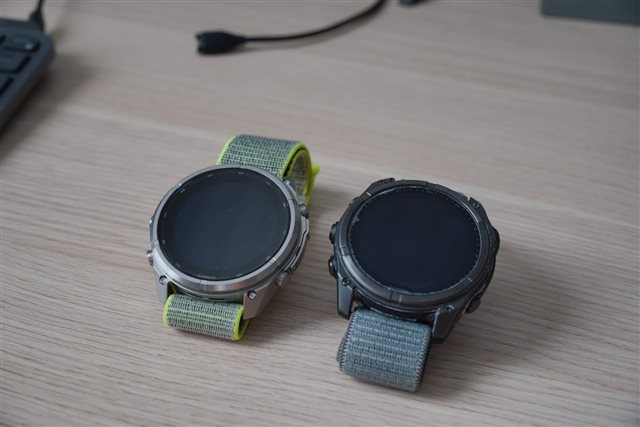
This is obviously subjective, but for me the Fenix 9 Pro Solar is a substantial visual step backwards from the Fenix 8 Solar.
I do not mind large watches at all. In fact, I generally prefer them. So the additional thickness itself is not a problem aesthetically. It is, however, very noticeable on the wrist. What I find particularly disappointing is that the non-LTE and LTE versions appear to use the same overall case thickness. If the additional internal volume is partly there to accommodate the inReach/LTE hardware architecture, making the non-LTE version equally thick feels like a missed opportunity.
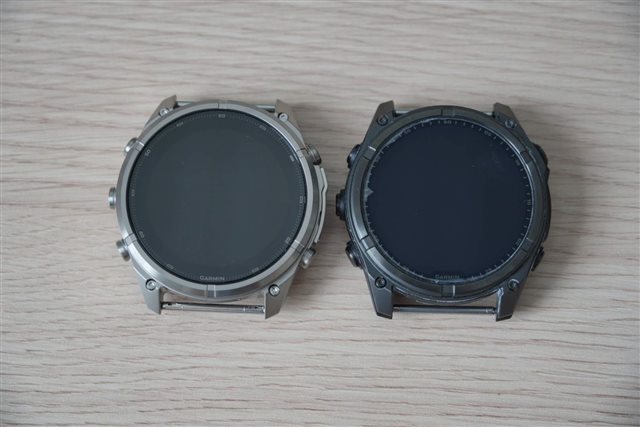
The much larger solar ring is my biggest design objection. On the Fenix 8 Solar, the solar ring is relatively unobtrusive. On the Fenix 9 it visually dominates the display and, in my opinion, makes the watch look much less refined and somewhat toy-like.
What I miss even more is the case geometry of the Fenix 8 Solar.
On the F8, the bezel is visually smaller than the main watch body. This creates distinct case “shoulders” around roughly the 2, 4, 8 and 10 o'clock positions. Together with the comparatively flat, almost horizontal upper bezel surface, this gives the watch a very athletic appearance: slim in some areas, muscular in others.
The Fenix 9 bezel transitions much more continuously into the case and slopes outward in a wedge-like fashion. To my eyes this makes the entire watch look more conical and less sculpted.
There is another detail that I did not fully appreciate until putting both watches next to each other: the darker polymer middle case on the Fenix 8 creates additional contrast between bezel, center case and rear structure. That contrast gives the F8 more visual depth and more clearly defined individual components.
The full-titanium Fenix 9 case may be more premium from a material perspective, but visually it actually looks less detailed to me because more of the case becomes one continuous metallic mass.
So while I understand why others may prefer the F9, I personally find the F8 Solar considerably more attractive.
GPS performance
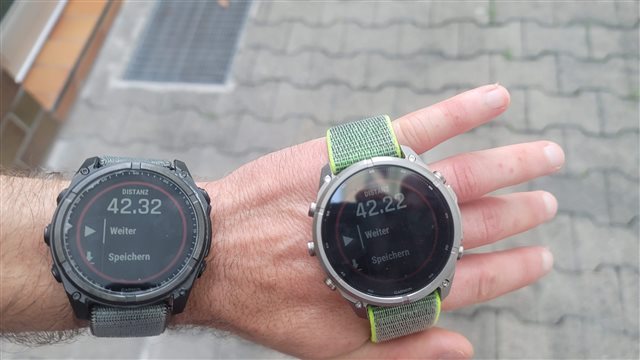
I have now performed several direct F8 Solar vs F9 Pro Solar runs with both watches recording simultaneously, with identical settings and one watch on each wrist.
Overall GNSS performance is excellent on both watches. There is no clear generational leap in absolute positioning quality.
However, a consistent pattern has appeared.
The F9 track tends to be slightly smoother and slightly shorter. The F8 track contains a little more fine geometric variation and repeatedly produces a somewhat longer total distance.
The difference does not disappear completely when both tracks are mathematically smoothed, suggesting that this is not simply additional random jitter from the F8.
More interestingly, in two recent runs, spatial cross-correlation indicated that the F9 position solution matched the F8 best when shifted by roughly 1.3–1.5 seconds. A marathon test showed the same tendency, although less strongly.
My current interpretation is that the F9 uses somewhat stronger positional filtering, producing a visually cleaner track at the cost of additional latency and possibly slightly more corner cutting.
One amusing indication of how accurate modern GNSS has become: in repeated runs it was statistically possible to determine which watch was worn on which wrist. The F8 was on my left wrist and the F9 on my right, and that lateral relationship could actually be recovered from thousands of recorded coordinates.
That does not mean every individual GPS fix is accurate to wrist-width precision. Rather, common GNSS errors cancel statistically over thousands of samples while the persistent left/right offset remains visible. Still, it is impressive.
My conclusion so far is that GPS performance is essentially a draw. The F9 produces the prettier track; the F8 appears slightly less filtered.

Altimeter performance
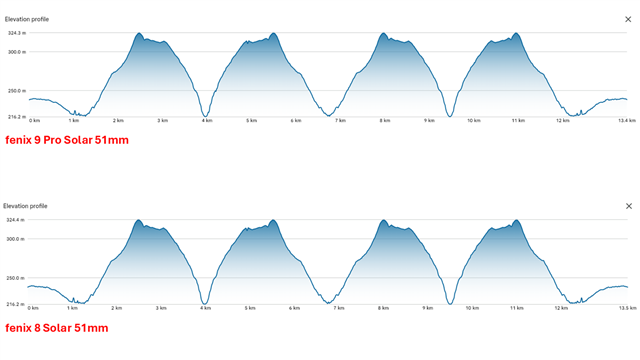
This has been tested more systematically than simply comparing elevation graphs visually.
Both watches were calibrated at the start of each activity, with continuous calibration enabled and altimeter mode set to Auto.
I repeatedly ran the same hills in both directions and then compared the recorded elevation against official German DGM1 terrain data with a one-meter grid.
The latest test included eight repeated traversals of approximately the same 108 m elevation difference.
The average measured elevation differences were approximately:
- DGM1 reference: 107.7 m
- Fenix 8: 106.0 m
- Fenix 9: 106.5 m
The F9 therefore came slightly closer to the terrain reference.
Repeatability was also excellent on both watches. Across the eight hill traversals, the standard deviation of the measured elevation change was approximately:
- F8: 0.67 m
- F9: 0.49 m
When the constant absolute elevation offset was removed and the complete elevation profiles were compared against DGM1, the F9 again performed slightly better in the latest test.
Approximate offset-corrected errors were:
- F8 MAE: ~0.91 m
- F9 MAE: ~0.81 m
- F8 RMSE: ~1.16 m
- F9 RMSE: ~1.03 m
Interestingly, both watches showed almost exactly the same scaling behaviour relative to DGM1. Relative elevation changes were compressed by roughly 1.3%.
That strongly suggests a shared algorithmic or atmospheric-model effect rather than an individual pressure-sensor calibration error.
The F8 did, however, perform slightly better in another respect: returning to the original start point after a long activity, its final elevation tended to remain closer to its starting elevation. So far the F8 seems slightly better at maintaining its initial offset, while the F9 tends to produce the more accurate absolute elevation and total ascent.
In the most elevation-heavy test, DGM1 indicated approximately 454 m total ascent.
Using the same processing methodology:
- F8 recorded approximately 448 m
- F9 approximately 451 m
Again, both are very good, with a slight advantage for the F9.
Map performance
This is probably the largest functional improvement I have found.
Garmin advertises faster map panning, and yes, the F9 is faster. But I think that focuses on the wrong metric.
The much more important difference during actual navigation is the update rate when the map rotates as your heading changes.
On the F8, map orientation can feel sluggish. On the F9 the map follows heading changes much more quickly, and this makes navigation feel substantially more responsive.
Combined with the new Perspective View, this is a genuine improvement rather than a specification-sheet feature.
Perspective View also makes much more sense in actual use than I initially expected. On a small round display, placing your current position toward the lower part of the screen and showing more of the terrain ahead is useful while running.
For me, the combination of Perspective View and the much faster heading/map-rotation updates is the strongest argument in favour of the F9.
Unfortunately, route recalculation itself does not appear to have improved nearly as much.
If I deliberately leave a route and continue running, rerouting can still enter the familiar loop where the watch calculates a new route, my position has changed significantly by the time the calculation finishes, and another recalculation starts immediately.
Wired charging
This is one difference I have not seen mentioned elsewhere yet.
Using the same power source and the same cable, with both watches below 50% state of charge:
- Fenix 8 Solar: approximately 2.1 W
- Fenix 9 Pro Solar: approximately 3.4 W
That is roughly 50% higher input power on the F9.
How much difference this produces, when performing a full charging cycle, yet has to be tested.
But it strongly suggests that Garmin has increased the permissible charging power or changed the power-management/charging circuitry.
A full controlled charge curve would be needed to characterize this properly.
Solar performance
This has produced one particularly strange observation.
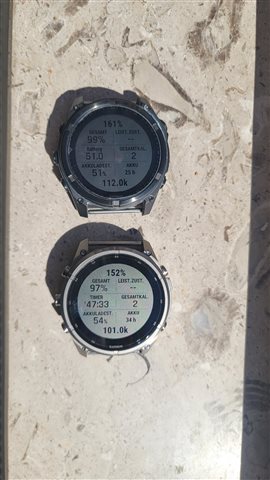
When both watches are placed next to each other in direct sunlight under effectively identical conditions, my F8 consistently reports approximately 7–9% more accumulated solar intensity than the F9.
For example, during one 1 h 47 min exposure:
- F8: 108
- F9: 102
This initially looks backwards because the F9 has the visibly much larger solar ring.
However, the Garmin solar value is based on illuminance, i.e. lux over time. Lux is an area-normalized photometric quantity and therefore cannot directly tell how much electrical energy the entire solar collector produces.
A larger collector can receive slightly lower measured illuminance while still generating more total electrical power.
To estimate the actual solar contribution, I instead worked backwards from Garmin's published battery-runtime figures.
The principle is simple.
If a watch lasts T_0 hours without solar and T_solar hours with a specified 50,000-lux exposure, its basic battery consumption is:
1 / T_0
of the battery per hour.
Its effective consumption under solar is:
1 / T_solar
The difference between the two is therefore the effective solar contribution expressed as a fraction of total battery capacity per hour.
Applying this to multiple operating modes gives remarkably consistent results.
For the Fenix 8 Solar 51 mm, Garmin's various published runtime figures converge on approximately:
0.384% of battery capacity per hour at 50,000 lux.
For the Fenix 9 Pro Solar 51 mm:
approximately 0.525% per hour.
That corresponds to roughly:
37% more effective solar energy per hour relative to battery capacity on the F9.
The interesting thing is that the calculation remains surprisingly consistent across very different operating modes, suggesting Garmin is using a reasonably coherent internal solar-power model.
The visual design of the F9 solar ring strongly resembles the large-ring approach used on the Enduro 3, so it is tempting to assume they are technically identical.
Applying the same reverse calculation to the Enduro 3 results in an even larger effective solar contribution, roughly around 0.54–0.56% of battery capacity per hour at 50,000 lux.
Overall impression
The GNSS performance is not meaningfully better than the already excellent F8 and the altimeter appears slightly more accurate and repeatable in my tests, but really not a big difference.
Sysrem performance also is not really noticeably faster - both watches behave pretty much the dame.
Mapping is the only real difference here: paning/zooming is clearly improved, but the much faster heading/rotation response and Perspective View are the real change here and the only argument for the new Fenix 9.
Big disappointment, however, considering route calculation and rerouting while navigationg: if this has improved, it is not clearly noticeable and still absolutely terrible. Rerouting still is practically non working, as it ends up in a recalculation loop if you keep on moving, after you went off course.
Solar performance appears to have improved, but battery-life is already 'solved' with the Fenix 8 solar. I'd much rather have a smaller bezel and decreased battery life than having to look at this toy-like appearance. Even without the solar benefit, battery-life is already good enough. Why would Garmin maximize Solar on the Fenix if they have the Enduro line?
One nice observation is the quicker wired charging, bur I'd loved to see inductive charging as an alternative.
Overall, for me, the F9 currently represents an unusual trade-off:
the better navigation device, but the less attractive watch.
I'll keep my Fenix 8 Solar 51mm just for the looks. Although the mapping is a strong benefit, the Fenix 8 is so much prettier and sexy looking - a real showpiece. Additionally, it's unacceptable not to offer the Fenix 9 Pro Solar in the dark DLC version.


