Fenix 7 Pro Losing Heart Rate During Activity

I recently switched from a Fenix 6 to a Fenix 7 Pro Solar model and while I'm happy with it overall, I'm finding that it is much more unreliable when it comes to recording my heart rate during activity. 

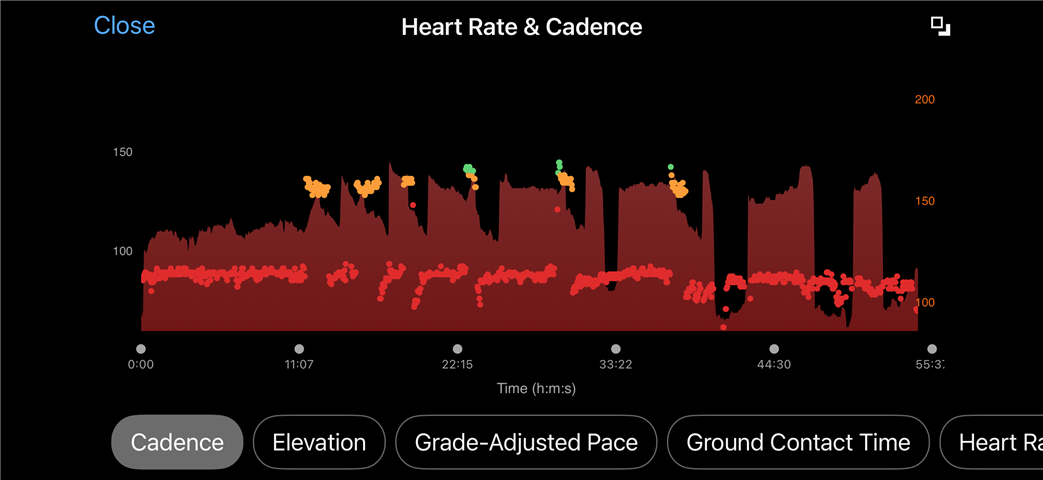
This is from a run/walk session yesterday... As you can see, each time I'd start running, the heart rate would drop to a value 20-40 bpm less than what I was actually experiencing, and the issue got worse as it went on, until at the end as I was walking home, it dropped down to 60-70 bpm and wanted to stay there. 

I've read all of the recommendations for getting good readings - I wear the watch well above my wrist bone, keep it tight so it doesn't move around, have cleaned the sensor, etc. I've even tried shaving the hair from my arm so it can get a better reading. I've tried wearing it on the underside of my arm, with no meaningful difference in how it registers. Yesterday, as I was walking, I got it to re-establish my regular heart rate once by pressing down very hard, but then later it didn't (hard enough that it would be impossible to tighten the strap to that level). On other runs I've tried powering down and turning it back on again, stopping the run and resuming, etc. I've tried taking it off my wrist them putting it back on to make it re-find my heartrate, and that sometimes works, but weirdly sometimes does not. 

I didn't have this issue with the 6. I know about cadence lock, but this doesn't seem to be that, since it's dropping during running, not rising. 

Any other suggestions about what I could try? Do I just have a defective watch? I did my research when purchasing and it looks like the 7 Pro and the 8 have the same sensor, but are the 8s prone to this kind of inaccuracy? I'm super frustrated since it seemed like this watch should be better than my old one, not worse. 

Top Replies

  • I didn't have this issue with the 6. I know about cadence lock, but this doesn't seem to be that, since it's dropping during running, not rising.

    It is a cadence lock. Cadence…

All Replies

  • I didn't have this issue with the 6. I know about cadence lock, but this doesn't seem to be that, since it's dropping during running, not rising.

    It is a cadence lock. Cadence lock means the optical sensor detects the noise added by the motion (feet hitting the ground, arm swinging, watch bumping the veins,...) generating false optical signal in the blood stream. The resulting curve that the watch detects, can be equal to the cadence, but it can be also a result of the interference between the noise signal and the true HR signal, so the result is more or less unpredictable, and can be both higher or lower than the actual HR. 

    If adjusting the tightness and the position of the wristband (a bit upper above the wrist bone), and/or warming up a little bit longer, do not help, then I am afraid there is not much you can do, except of using an external HRM (which is highly advisible for any serious training anyway), or changing the model.

    Do I just have a defective watch? I did my research when purchasing and it looks like the 7 Pro and the 8 have the same sensor, but are the 8s prone to this kind of inaccuracy?

    I do not think your device is defective. As far as I know Fenix 7 uses a different version of the HR sensor (F6 = Elevate 3rd generation, F7 = Elevate 4th generation, and F8 = Elevate 5th generation). It does not mean Elevate 4 is worse than Elevate 3. It is rather individual. The algorithms are tuned for a typical user, though. So even if you get the newest and the best sensor, there is no warranty it works better for you than the previous one.

    Each individual is different, for some it may work perfectly, while others may have problems like you have. I am one of the lucky persons who has no locking issues at all (even during freezing weather in winter, when it tends to be worse), regardless whether I use a watch with Elevate 3 or 4, but I use a chest strap HRM anyway. Besides others, it also allows me to compare the curves from the optical sensor and from the external HR, and I do see that they are practically identical all the time, which then assures me I get accurate metrics even when I do not use the HRM.

    That told, since you have the watch only briefly, I advise changing it for a different model. Trying another Fenix 7 will almost certainly not help, and I do not believe Garmin is going to make any modifications of the algorithm on that particular model. First of all, I'd try a lighter model such as some of the Forerunners, Instinct 3 (if you do not need maps and music), or others, before going for Fenix 8. The weight of the watch has an important impact on the level of signal noise.

  • This is a 7 Pro, which I believe uses the same sensor as the 8 (5th gen). 

    I'm not interested in the lighter models, as the mapping features are one of the reasons I wear a fenix. I'm just puzzled by the fact that my 6 handled this just fine, and a sensor two generations newer cannot. From Garmin's perspective, building a health and fitness watch that does a good job of measuring heart rate except when you're working out is a huge fail. 

    Also, I would think that if the problem were purely cadence lock, then stopping (standing still) or walking should eliminate it. As you can see in the graph, it did not. 

    Thanks for the response.

    Stephen

  • Also, I would think that if the problem were purely cadence lock, then stopping (standing still) or walking should eliminate it. As you can see in the graph, it did not.

    I cannot see that on the graph. I see cadence around 110 spm most of the time, with some peaks of ~155 spm, and one drop to ~90 spm. There are no pauses with zero cadence, as far as I can see.

    Since you did not use any HRM, we do not know what the true HR was, and we will never know how the combined curve of the true HR and the cadence-induced noise looked like.

    If you still have the old F6, record a run with both of the watches simultaneously, and post the graphs or both of them. Even better, get a HRM strap (a cheap one for a few bucks is sufficient, though a HRM 600 or HRM-Pro are a much better choice with many other advantages), and when you record a run with it, export the activity, and post the zipped file here - we can then exactly see where the HR from the internal sensor differs.

  • There is only one time on that outing that I stopped completely - that sort of shows at 42 minutes. But I've done it repeatedly on other outings. As I said in the first post, I've tried everything including stopping, taking the water off, moving it far up my arm, restarting the run, and even restarting the watch, waiting for it to restart, and then picking up the walk again. 

    And yes, if I still had the other watch, I would do that, but I sold it, thinking I was getting a better one. 

    I don't really care if I am getting my 100% true heart rate or not. In the past, the wrist worn hrm was plenty fine to get a good idea of the workout, but looking at this, the dropouts are clear, and represent a large fraction of the workout time. That's the part I think is crap on Garmin's part. I don't expect the watch to be as accurate as a chest worn monitor, but I do expect it to be able to tell the difference between 140bpm vs 70bpm for minutes at a time. 

  • As an opening statement: I agree with all  wrote.

    However if you heeded all these advice and still have this problem: this is not a new problem, see e.g. here:

    https://forums.garmin.com/outdoor-recreation/outdoor-recreation/f/fenix-7-series/408780/wrist-heart-rate-still-broken#pifragment-1292=3

    I was able to confirm exactly what you describe with now 4 units on firmware 21.19 - 26.09 to the very same outcome compared while using those simultaneously with my daily T7 still on 15.77. Ofc. not all 5 at the same time... ;-) All of those units worked as expected and to my satisfaction again if downgraded to 15.77-17.28. This problem was gone instantaneously after downgrade. How would I know that my daily unit on 15.77 does it right? Ofc. I compared it to medical devices not only right at the beginning but ongoing again every now and then. In fact it is impressive what a Fenix 7 series OHR sensor is capable of provided it is driven by the right software in which case it is not even neccessary to wear a strap most of the times. The is a CIQ App "OHR vs. Strap delta" and with 15.77 - 17.28 there is no delta worth mentioning expect if you do training with VERY rapid changes in HR which is and inherent problem of any OHR sensor.

    This all said: there is a way to test if you can get rid of this: load something like 17.28 onto your Fenix and see if it is gone. Are there drawbacks? Yes. You will be no longer able to install any CIQ content using the CIQ mobile App. However you can reinstall almost everything using GE as long as you had it installed previousely while on recent software. This is more difficult with 15.77, but almost no problem with 16.22 or 17.28 b/o the CIQ version.

    If you want to learn more about software versions, proposed fixes etc. always consult the tremendous changelog still maintained by   

    https://forums.garmin.com/outdoor-recreation/outdoor-recreation/f/fenix-7-series/350860/garmin---fenix-7-epix-2-series---excel-changelog/2005822# 

    or more directly and still uptodate here: https://bit.ly/40m2Rad

    I'm very grateful for the work he did; w/o him there wouldn't be such a comprehensive collection of software versions. It is thanks to him that I'm even able to write: If you want to give it a try: PM me. 

    FYKI: it's b/o this problem (and others like DEM and many more) I'll never use anything later 17.28 for my daily system if there won't be a considerable improvement coming after 26.09. But I lost hope. Did I report my findings and comparisons? Ofc. The answer is the same for what ever problem: Versions well below the recent version are not valid for comparison...Well, there are no problems at all if you define a working status as not valid after all.